Fernão GOMES
(Alburquerque, 1548 - Lisbon, 1612)
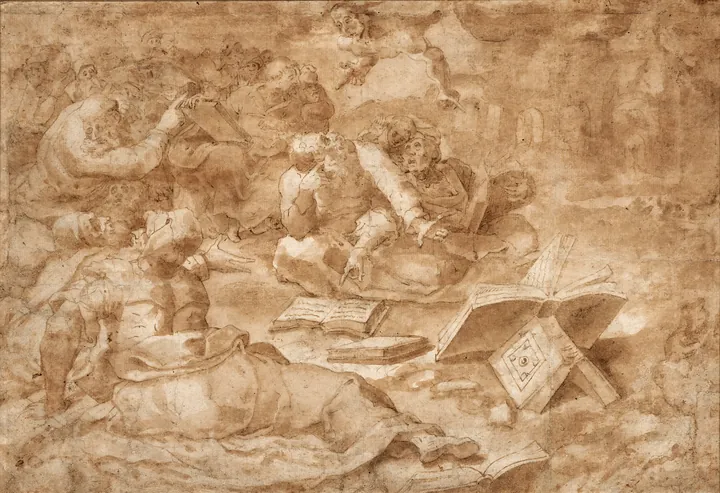
The Dispute between the Doctors (?) (?)
Pen and brown ink, brown wash, white gouache
10 7⁄16 × 15 1⁄4 in. (26,5 x 38,8 cm)
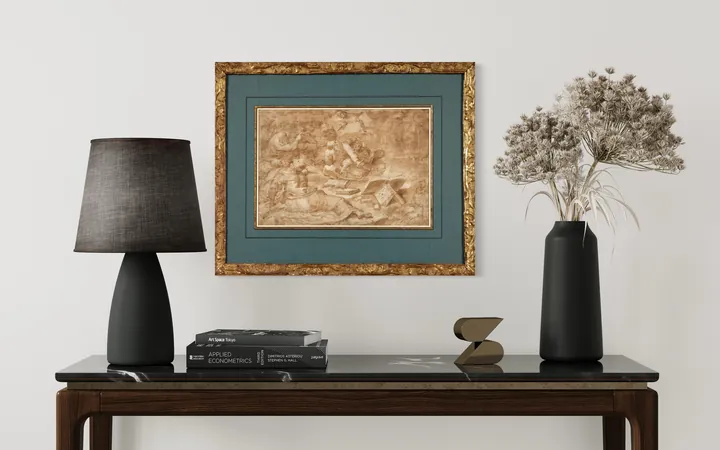
Louis XIV period gilded frame - 18 1⁄2 × 23 1⁄4 in. (47 x 59 cm)
We warmly thank Professor Vitor Serrão for confirming the attribution of our drawing to Fernão Gomes (written communication, 30 September 2025). A historian and specialist in Portuguese art, he has published several reference studies on Portuguese Mannerism and on Fernão Gomes.
Artwork description
A rediscovered work, a rare example of Portuguese Mannerism
Formerly attributed to Toussaint Dubreuil (as suggested by an inscription on the verso), and more recently considered anonymous, the present drawing has been re-attributed to Fernão Gomes by Christophe Defrance, thanks in particular to the very strong graphic similarities it shows with a sheet (ill. 1) held at the Museu Nacional de Arte Antiga in Lisbon. This drawing, signed and dated 1599, is a preparation for the large Ascension du Christwhich unfortunately disappeared, like most of his work, following the Lisbon earthquake of 1755.

The Ascension of Christ - 1599
Pen and brown ink, brown wash and white chalk highlights - 49.4 x 37.5 cm
Lisbon, Museu Nacional de Arte Antiga
Our artist, born in Albuquerque in Castile, trained in Delft with Anthony Blocklandt (1533-1583) before settling permanently in Lisbon in 1573, where he met with great success: in 1594, he was appointed "oil painter to his majesty" by Philip II of Spain (1527-1598)(1).
By comparing the two drawings, we can clearly attribute our sheet to Fernão Gomes, since their stylistic characteristics are so similar. Of particular note are the highly stylised faces (ill. 2), with exaggeratedly elongated limbs and outré poses and attitudes, and the excessively muscular and deformed hands, with the thumb and little finger spread impossibly far apart. It is also worth noting that the figure of the apostle raising his arm (on the right of the image on the left of ill. 2) is the same as that of the doctor pointing to a Bible (central image of ill. 2).
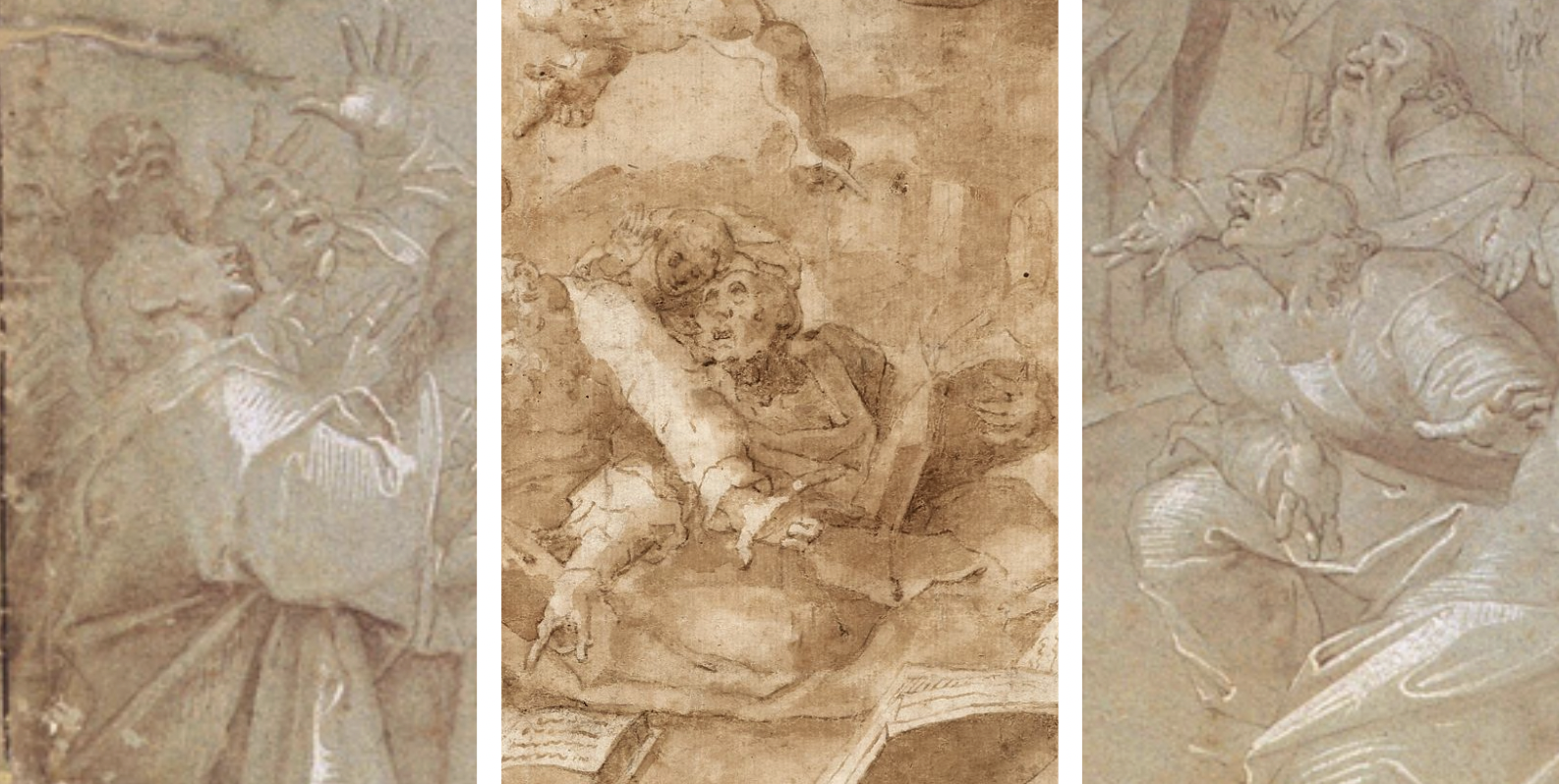
These characteristics make our drawing a very rare example of late Mannerism in Lisbon, a synthesis of innovations from Italy, their reinterpretation by the Nordic countries and the initial aesthetic effects of the Counter-Reformation fostered by Spanish rule.
A very free iconography, open to multiple exegeses
On a rocky ground, an assembly of middle-aged men, divided into three distinct groups, ardently debate around open books. Their highly expressive attitudes convey a heated and passionate discussion. The drama of the conversation is emphasized by the robust treatment of the figures and the heavy draperies, directly evoking the terribilità of the prophets in the niches of the Sistine Chapel. The composition is structured around the central group, upon which descends—tongue sticking out—a frightening figure with a skull-like head. How should we interpret this scene with its unusual iconography?
Vitor Serrão interprets it as Jesus among the Doctors, where the youthful figure at the center, leaning over the two elders, would be the young Christ. The subject could also be The dispute between the Doctors of the Church, an important theme in the context of the Counter-Reformation: faced with the emergence of Protestantism, the aim was to reaffirm the correct interpretation of the Bible. In this reading, the young man could be understood as an angel guiding the doctors in their theological debate, while the monstrous figure would embody an allegory of Protestant heresy, attempting to mislead the faithful of the Church.
Professor Hélio Alves, a specialist in Portuguese literature of the 16th and 17th centuries, instead sees a profane debate and suggests the hypothesis of an Allegory of False Wisdom(2). In a kind of parody of Raphael’sSchool of Athens philosophers with exaggerated and grotesque features exhaust themselves in sterile discussions far removed from biblical truth. In this interpretation, the arches in the background on the left would refer to Greek antiquity, and the rocky ground would invite us to situate the scene in Plato’s cave, plunged into the shadow of illusion and out of reach of divine light.
Framing and condition report
Our drawing, partially light-faded, is backed with Japanese paper and float-mounted. It has visible losses on the left side. We present it in a mounting in the style of Mariette, framed in a gilded Bérain-style frame from the Louis XIV period (18 1⁄2 × 23 1⁄4 in. - 47 x 59 cm).

(1) Vitor Serrão, "Fernão Gomes, Pintor maneirista de bravo talento" in Revistas Oceanos, no. 1, June 1989, p. 27
(2) Written communication, 3 October 2025