


Niccolò RICCIOLINI (Rome, 1687-1772)
Mosaic projects for Saint Peter's in Rome
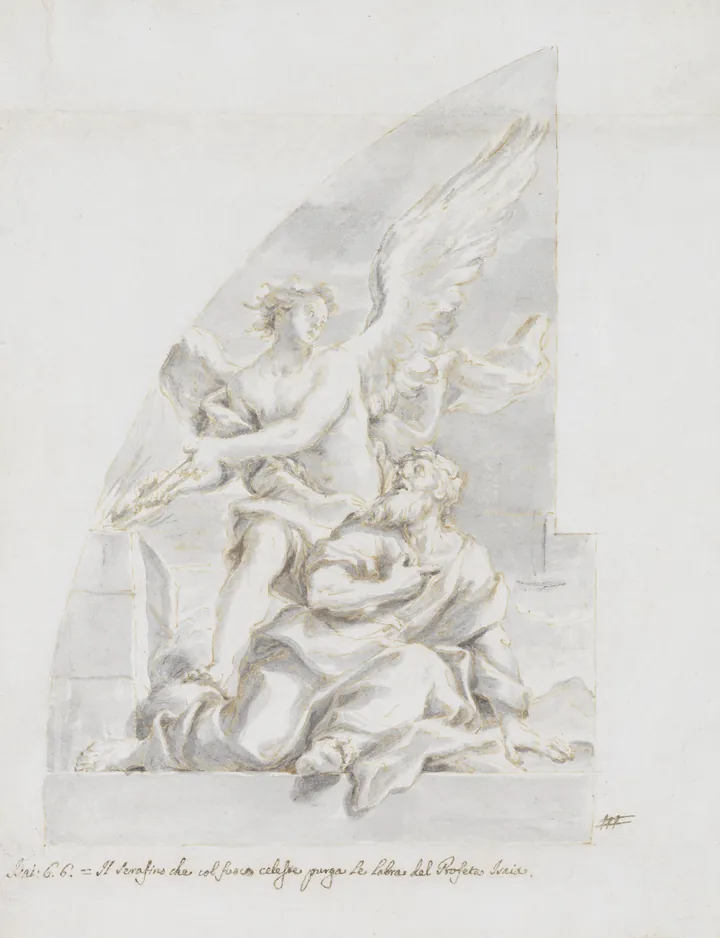
The seraph purifies the prophet Isaiah's lips with fire
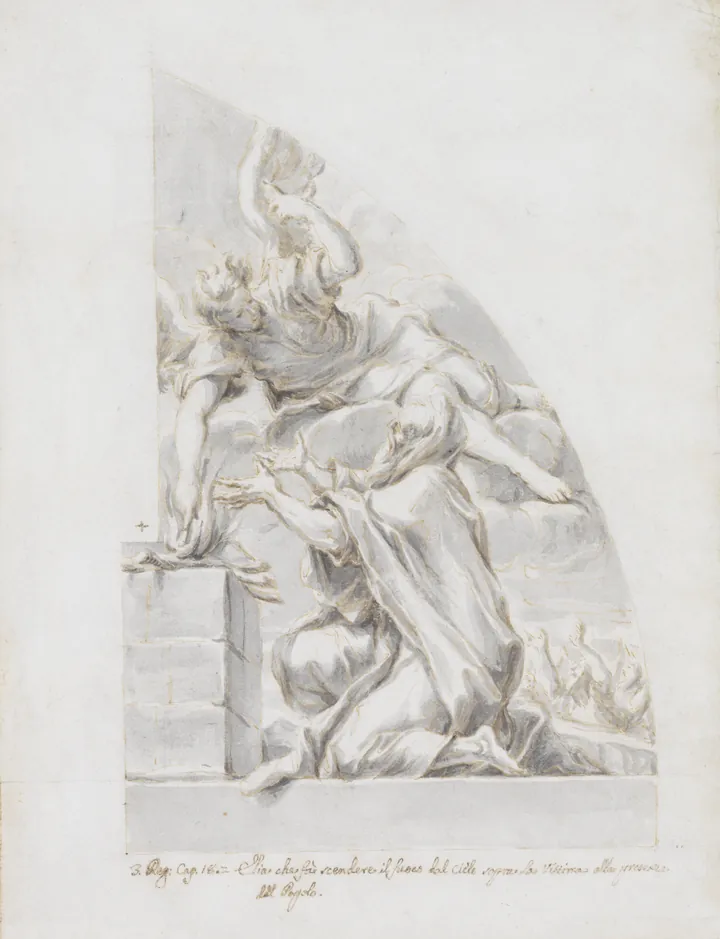
Elijah brings down fire on Ahaziah's men
Circa 1730
Pen and brown ink, grey wash
Each drawing: 11 × 8 1⁄2 in. (27.9 x 21.5 cm) - Gilt frame: 17 1⁄4 × 25 7⁄8 in. (43.8 x 65.7 cm)
The drawings are annotated in pen under each scene:
- "Isai : 6.6. - Il Serafino che col fuoco celeste purga le labbra del Profeta Isaia."
- "2. Reg : Cap. 18. - Elia che fà scendere il fuoco dal cielo sopra la Vittima alla presenza del popolo"
We would like to thank Professor Vittorio Casale, a specialist in the Roman Baroque who has published several works on Ricciolini, for his help in compiling this notice.
Artwork description
Two rare subjects
Both subjects are taken from the Old Testament. The first (ill.1) (Isaiah, 6) recounts an episode in the life of the prophet Isaiah. Complaining of having unclean lips, he was healed by a seraph who touched him with a burning firebrand. The angel said: "Behold, this has touched your lips; your iniquity is taken away and your sin atoned for". Note the liberty taken by the artist in depicting the seraph with two wings instead of the usual six.

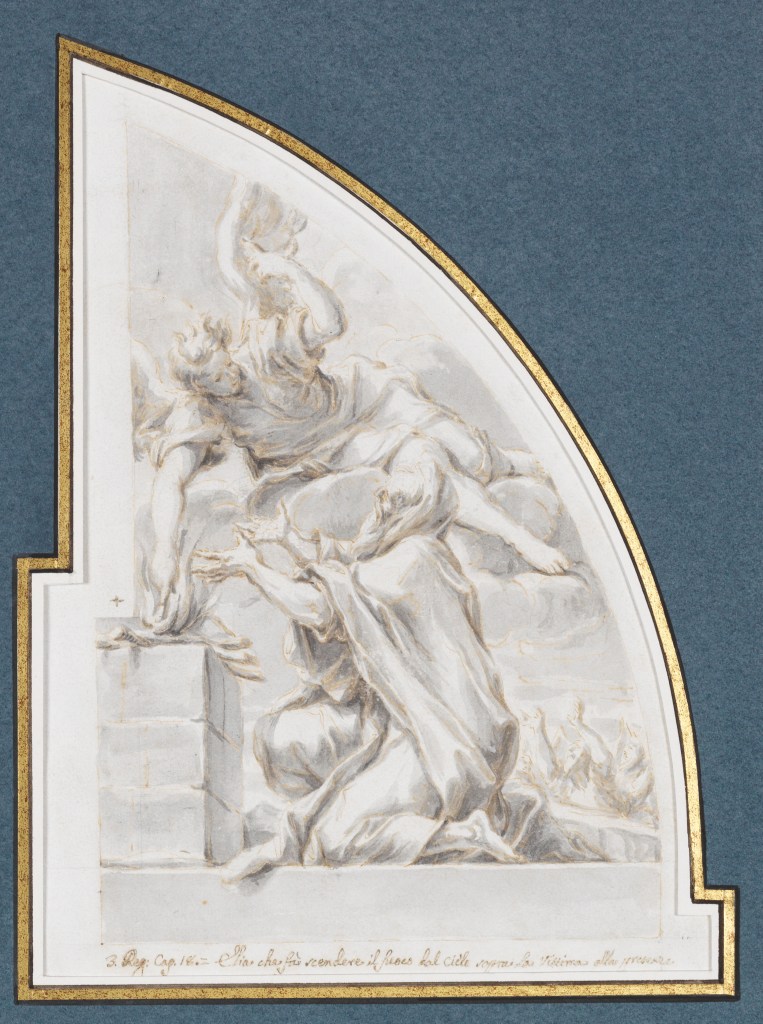
The second (ill. 2) (Kings, II, 1) recounts an episode in the life of Elijah. The prophet is about to bring down divine fire on the soldiers that the impious king Ahaziah has sent to meet him. Our drawing illustrates the moment before the punishment: the angel, summoned by Elijah, points the sacred fire at an altar and points to the sky from which it will fall. At the bottom right of the composition, we can see the soldiers who, having understood their doom, implore God's forgiveness in vain.
Modelli for mosaics at St Peter's in Rome
The two sheets are part of the same ensemble. The compositions are in counterpart, with the human figures in the centre, kneeling on a massive base, while the angels close off the upper part. The two scenes are also linked iconographically. They represent two divine interventions linked to fire: the fire of healing on the left and the fire of punishment on the right.
Our drawings are clearly modelli for the two sides of a lunette framing a central window. They can be compared with a sheet by the artist in the same format, published by Vittorio Casale(1) (ill. 3), which was preparatory to the mosaic for a lunette in the choir chapel of Saint Peter's in Rome (ill. 4).
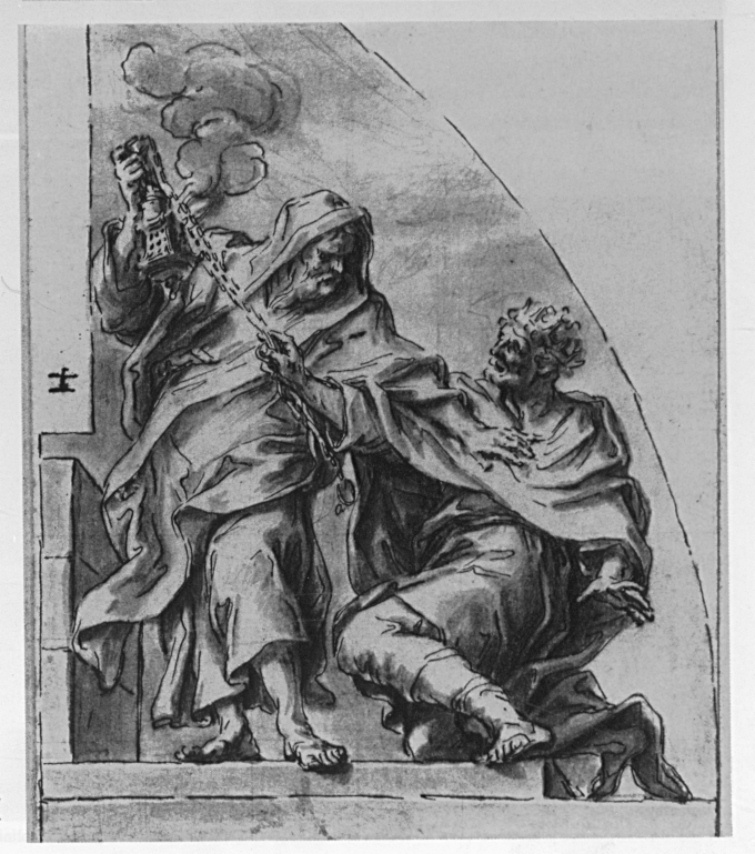
Azariah preaches to King Uzziah
Pen, brown ink and grey wash
New York, private collection
The relationship between our sheets and the one in New York is obvious from the identical format (they have the same indentation in the middle of the rectilinear side) and style. We can therefore hypothesise that our drawings are also projects for mosaics for a chapel in Saint Peter's in Rome, which were never realised.
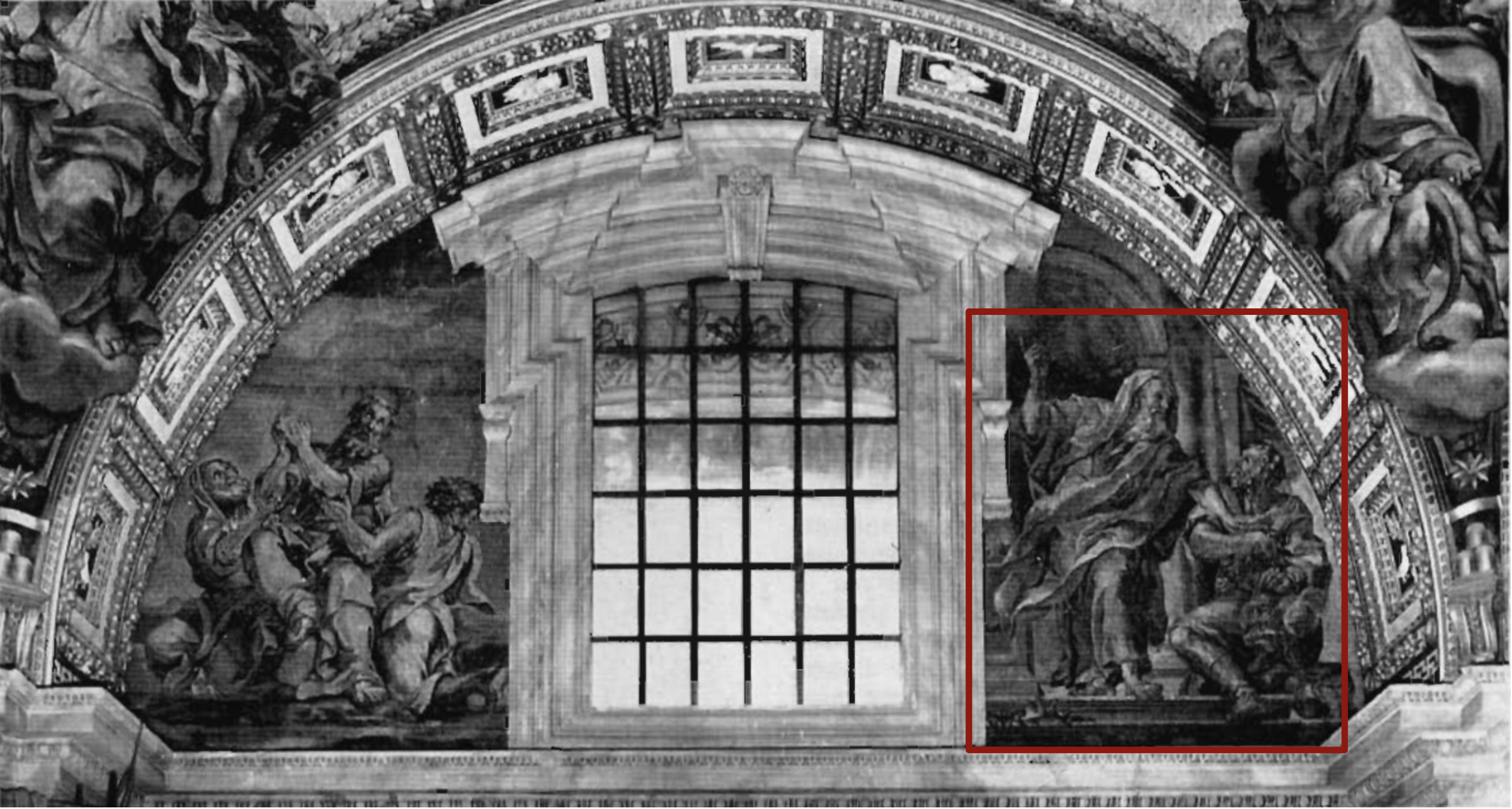
including one based on the New York drawing (ill. 3)
Moses prays, supported by Aaron and Hur and Azariah preaches to King Uzziah
The Vatican, St Peter's Basilica in Rome, choir chapel
Two drawings typical of Niccolò Ricciolini's early style
Dating from the third decade of the 18th century, our drawings belong to the first phase of the artist's activity, strongly influenced by the lessons of his father Michelangelo (1654-1715), with whom he collaborated until his death. They used lurid, moving effects reminiscent of Giacinto Brandi (1621-1691), diluted by chiaroscuro in the style of Francesco Trevisani (1656-1746) (to whom the artist was related, having married his niece, Laura, in 1717). It was during this period that Niccolò Ricciolini supplied the cartoons for the mosaics at Saint Peter's in Rome.

Self-portrait
Florence, Uffizi Gallery
While Ricciolini's later work shows a certain attention to the proto-Neoclassical reforms under the influence of Agostino Masucci (1690-1758), our two drawings are perfectly representative examples of his early style, faithful to the canons of the Roman barocchetto. Effectively underlined by frequent pen strokes and brought to life by the contrast between areas of shadow and half-light rendered by a subtly applied wash, the figures are skilfully articulated in constrained spaces. The whole appears as a kind of fluid, moving magma from which wings, clothes and bodies emerge with force. This remarkable quality helps to restore Ricciolini as a draughtsman to his rightful place in the late Roman Baroque.
Framing and condition report
Our drawings, float-mounted, are presented in a Mariette-style mount and framed in a gilded frame. We have chosen to mount our two sheets spaced apart, so as to recreate the configuration of two niches framing a window, like the mosaics in St Peter's in Rome. In this manner, our two works are presented in a way that restores their original purpose as modelli.
Our drawings are in excellent condition and have no notable defects.

(1) Vittorio Casale, “La dinastia dei pittori Ricciolini,” in Mario Di Giampaolo (ed.), Dal disegno all’opera compiuta, proceedings of the international conference held in Torgiano in 1987, Perugia, 1992, pp. 171–191, esp. p. 189, fig. 28.
The drawing illustrates the biblical story of King Uzziah who, having dared to enter the temple to burn incense for God (a privilege reserved for priests), was lectured by Azariah and then contracted leprosy as divine punishment. Ricciolini's drawing for the other mosaic, also for the same chapel, has not yet reached us. All three drawings (ours and the one in New York) have the same cruciform mark on the straight side, which can be explained by the fact that they come from the same collection.
For Niccolò Ricciolini, see also M.B. Guerrieri Borsoi, "Contributi allo studio di Nicolò Ricciolini", Bollettino d’Arte, 50-51, 1988, pp. 161-185.