Nicolò DELL'ABATE
(Modena, 1509 – Fontainebleau, 1571)
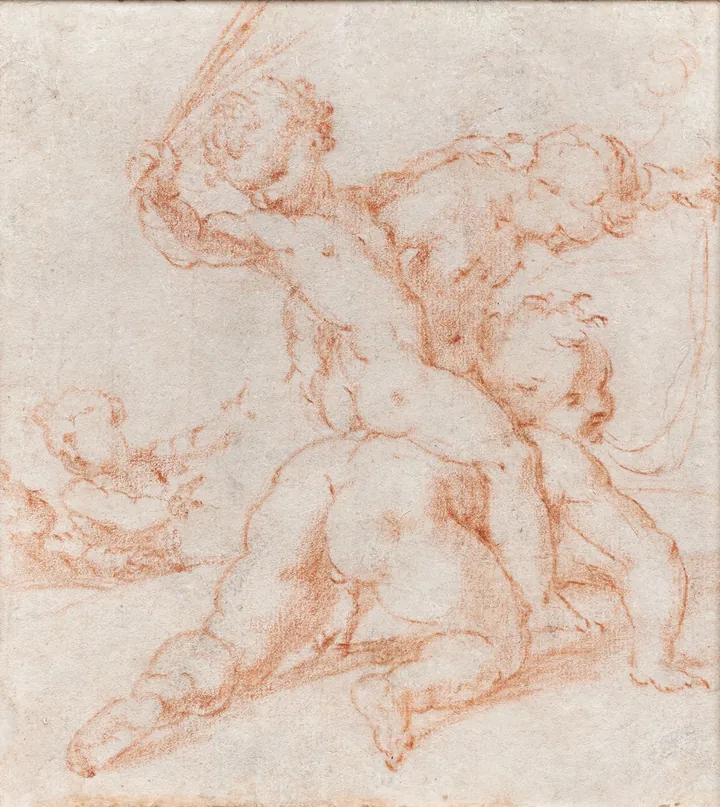
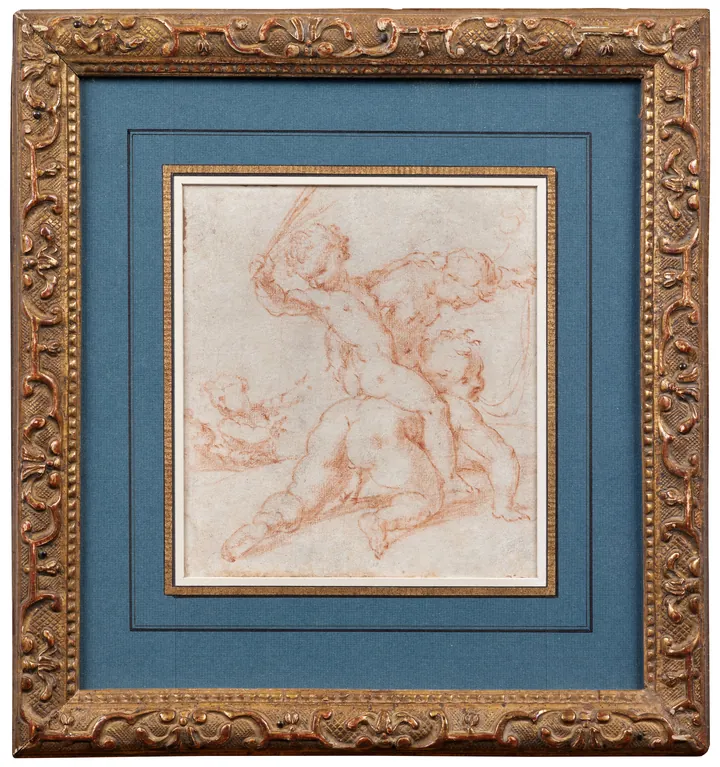
Putti Playing Horse
Circa 1560-1565
Red chalk
6 ¾ × 6 ⅛ in (17.1 × 15.6 cm)
Louis XIV period Bérain frame
Numéroté à la plume en bas à droite (trois chiffres partiellement effacés et illisibles, « 900 » ?)
Inscrit au verso : « Messere nicolo ou Rafael del Abbate » and « primaticcio » (trimmed at lower right)
We are grateful to Giulia Brusori for having written the present entry. An art historian specialist of Nicolò dell’Abate, she has published several studies on the artist’s drawings.
Artwork study by Giulia Brusori
Provenance:
Antoine-Joseph Dezallier d’Argenville (Paris, 1680–1765), his paraph lower right (L. 2951)
The drawing comes from the collection of Antoine-Joseph Dezallier d’Argenville, as indicated by his paraph at the lower right of the recto (L. 2951), together with a three-digit number that is difficult to read (900?). Although the number is hard to decipher, it appears to belong to the 900 series, consistent with Dezallier d’Argenville’s numbering system: the drawings by Nicolò dell’Abate in his collection are numbered from 901 to 905, positioned between Lelio Orsi (no. 898) and Pellegrino Tibaldi (nos. 906–911). The number on the present sheet can therefore only correspond to one of the missing numbers in this sequence (899, 900, 902, or 903)(1)Faithful to his chronological classification and organization by major schools, Dezallier d’Argenville frequently annotated his drawings, as in this case with the inscription “messere Nicolo,” identical to that found on drawing no. 904 in the collection of the Louvre Museum (inv. 5895).
The sheet, executed in red chalk, depicts five children. The three figures in the foreground at the center of the composition are engaged in play: one rides on another, whipping him with what appears to be a bundle of ears of grain, while a third holds him by a bridle. The two other children, at the left of the sheet, are conversing, while one of them extends his arms toward the main scene.
Nicolò dell’Abate, who arrived in France at the court of Henry II in the middle of 1552, was a great specialist in the representation of childhood throughout his artistic career, both in Italy and in France. One need only think, for example, of the putti he drew and painted at the beginning of his French career for the chapel of the Château de Fleury-en-Bière (Louvre, inv. 5843, 5892) and for the gallery of the Hôtel de Montmorency (Louvre, inv. RF 570), as well as on the site of the ballroom at Fontainebleau, where the artist from Modena, in addition to reproducing Primaticcio’s drawings on the arcades, was also entrusted with designing the putti at the summits of the arches (Louvre, inv. 5889, 8804)(2).
However, in this drawing the rendering of the figures - muscular and massive, and strongly influenced by the manner of Salviati and Michelangelo, whose drawings had circulated at Fontainebleau(3)- is closer to the style developed by the artist from the 1560s onward. This can be observed, for example, in the group of three putti t the lower part of the drawing representing Saint Augustine and Saint Geneviève (Windsor, RCIN 990146), a preparatory study for an altarpiece commemorating the death of King Francis II(4). The sixth decade of the sixteenth century marked the beginning of the political and dynastic crisis of the Kingdom of France. The death of King Henry II, who died accidentally from a wound sustained during a tournament at the Tournelles in July 1559, triggered the eruption of religious tensions into dramatic and bloody conflicts that continued until the beginning of the following century. Owing to the inability of the legitimate heirs to govern, Catherine de’ Medici retained control of the kingdom until her death in 1589. As a queen who was a woman, a foreigner, and of bourgeois origin, she was compelled to construct an artistic imagery to legitimize her authority to rule, centered on themes of landscape and pastoral, evoking ideas of fertility and peace, virtues regarded as quintessentially feminine. During this period, even the nobles of the court adopted this new iconographic fashion, as demonstrated by Jacques du Faur, a member of the privy council of King Charles IX, who commissioned Nicolò dell’Abate to paint the walls of the cryptoporticus of his Parisian hôtel with pastoral themes(5).
Thus, the iconography of the sheet fits perfectly within this stylistic and cultural moment. Although it is difficult to associate the drawing with a specific work, in part because of its rapid execution, close to that of a sketch, it may nevertheless be connected to the artist’s work for the queen’s numerous commissions, such as the festivities held for Carnival at the Château de Fontainebleau in early 1564, for which Pierre de Ronsard wrote his Bergeries(5). Moreover, this drawing is particularly remarkable in that it constitutes one of the very rare examples of red chalk from the final decade of Nicolò dell’Abate’s activity, from which mostly works executed in pen have survived(7).
Giulia Brusori
(translated from the original study in Italian)
(1) J. Labbé, L. Bicart-Sée, La collection de dessins d’Antoine-Joseph Dezallier d’Argenville reconstituée d’après son « Abrégé de la vie des plus fameux peintres », édition de 1762, Louvre, Département des arts graphiques, Paris, 1996, pp. 175-176
(2) G. Brusori, Nicolò dell’Abate in Francia: disegni e progetti decorativi. Proposta per un catalogo, thèse en cotutelle entre ALMA MATER STUDIORUM – Università di Bologna et l’École Pratique des Hautes Études (PSL), 2022, cat. 25, pp. 310-314
(3) G. Brusori, Per una revisione della cronologia dei disegni francesi di Nicolò dell’Abate: « L’Amore sulla mezzaluna » della Biblioteca Ambrosiana e il « Bacco » del Louvre, dans «INTRECCI d’arte», n° 9/2020, p. 37, note 10
(4) G. Brusori, Nicolò dell’Abate in Francia: disegni e progetti decorativi cit., cat. n° 46a
(5) G. Brusori, Nicolò dell’Abate: paesaggi per Caterina de’ Medici, in « Horti Hesperidum », 1, pp. 209-232
(6) G. Brusori, Nicolò dell’Abate in Francia: disegni e progetti decorativi cit., pp. 157-184
(7) G. Brusori, Nicolò dell’Abate in Francia: disegni e progetti decorativi cit., pp. 207-234