

Lorenzo BARTOLOMEO called Baccio CIARPI
(Barga, 1574 - Rome, 1654)
Saint John the Baptist
Before 1614
Oil on canvas
25 ⁹⁄₁₆ × 19 ¹¹⁄₁₆ in. (65 × 50 cm)
Italian 17th century frame - 31 ⁷⁄₈ × 25 ³⁄₈ in. (81 × 64.5 cm)
We thank Professor Federico Berti, an art historian specialising in Tuscan painting, for having written the present entry. The original signed entry in Italian is available on request.
The original study, in Italian, signed and dated by Professor Mauro Lucco, is available on request.
Artwork study by Federico Berti
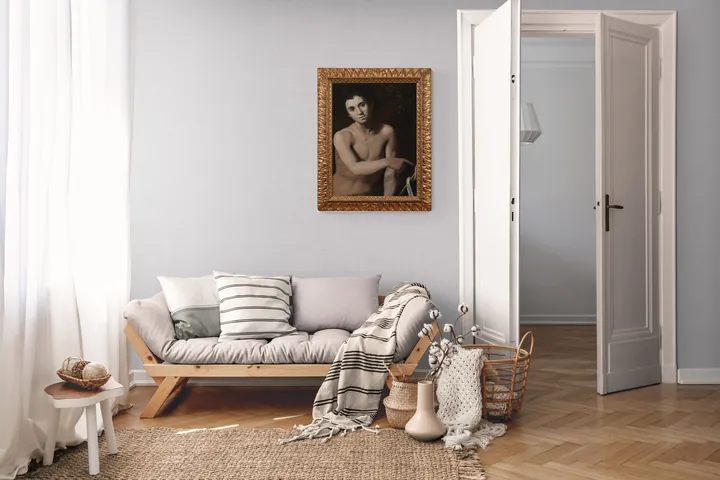
Our painting depicts the bust of a young Saint John the Baptist, seated and bare-chested, pointing to his characteristic attribute: his reed cross wrapped with the scroll bearing the inscription “ECCE AGNUS DEI.” The saint’s body, gently caressed by the light, stands out forcefully against the dark background, in keeping with the pictorial revolution brought about in Rome by Caravaggio (1571–1610) at the turn of the sixteenth and seventeenth centuries. The lessons of Merisi can notably be seen in the rapidly sketched foliage in the upper right corner of the composition.
Although imbued with a manifest naturalism—visible in the careful anatomical observation and in details such as the cast shadows that traverse the saint’s figure, from the chin to the shoulder and across the left arm—a closer examination of the work reveals a certain idealisation, particularly apparent in the Baptist’s face. This synthesis of nature and ideal, combined with the saint’s characteristic physiognomy, evokes less the direct followers of Caravaggio than the naturalistic experiments of Tuscan painting during the Counter-Reformation, nourished by the artistic innovations emerging from Rome.
Many Florentine painters were active in the papal city at this time, such as Cigoli (1559–1613), Passignano (1559–1638), Ciampelli (1556–1630), or Fontebuoni (1571–1626), to name only the most renowned(1). Among the Tuscan artists—generally quite faithful to their own figurative tradition—our painting is notably close, both in pictorial handling and in physiognomy, to two singular painters: Andrea Commodi (1560–1638) and the younger Baccio Ciarpi. Very close to one another, both were highly attentive to the new artistic developments emerging in Rome at the beginning of the 17th century. While Andrea Commodi is documented in the Eternal City as early as 1592, Baccio Ciarpi likely settled there toward the end of the 16th century, after training with Santi di Tito (1536–1603). Giulio Mancini (1559–1630) describes him as “Baccin da Barga, who today enjoys a fine reputation in Rome,” “a studious painter holding an academy in his home, of very Christian and pious conduct ”(2).
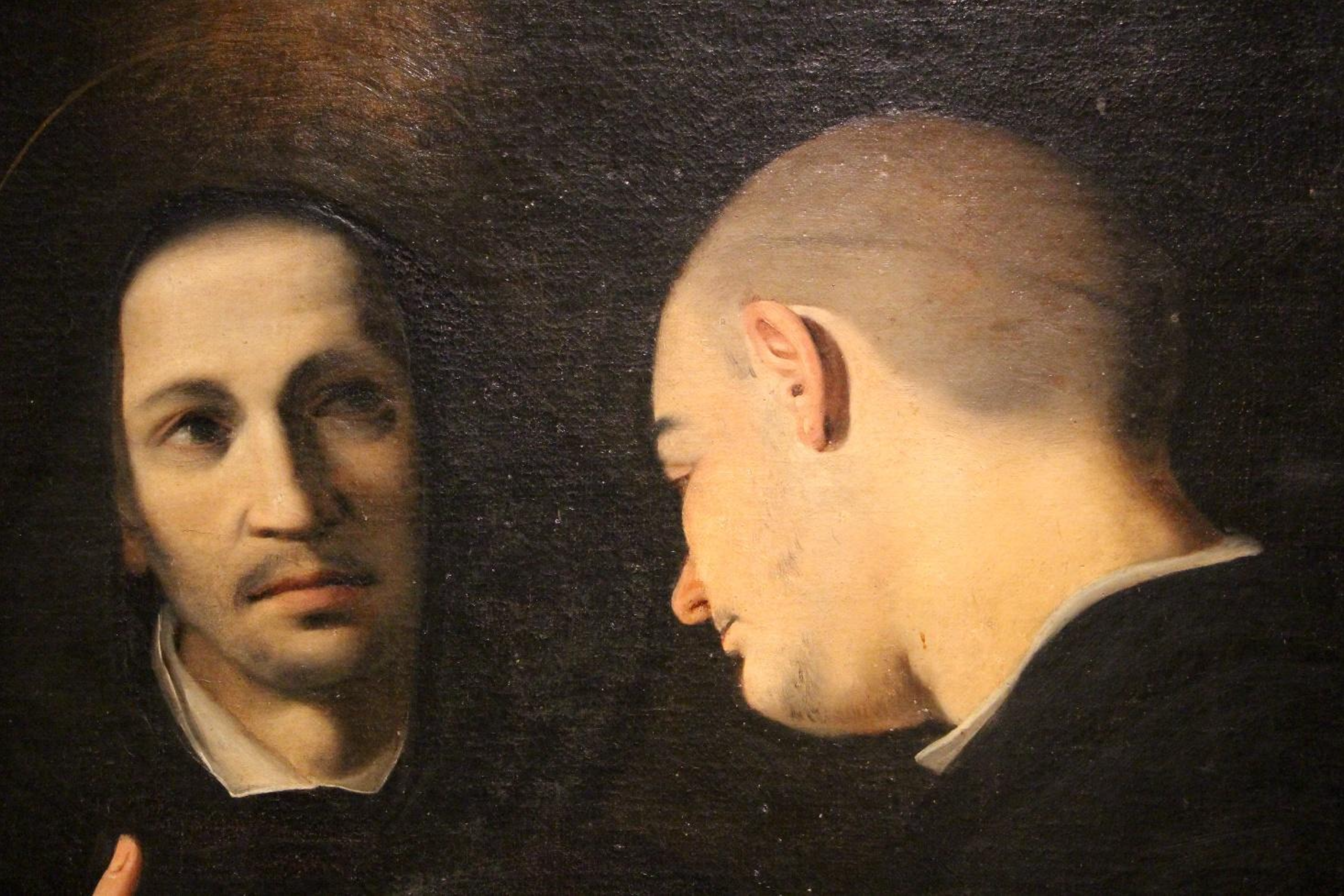
The stylistic proximity between the two artists(3) is reflected in the scholarly uncertainty surrounding works such as The Miracle of Saint Benedict (ill. 1), kept at the Accademia Etrusca in Cortona, attributed at times to one, at times to the other, but recently assigned with certainty to Ciarpi(4)This close link between the two Tuscan colleagues, attested by the biographer Giulio Mancini, is confirmed both by documented collaborations and by a shared characteristic: they were both, successively, the masters of the great Pietro da Cortona (1596–1669).
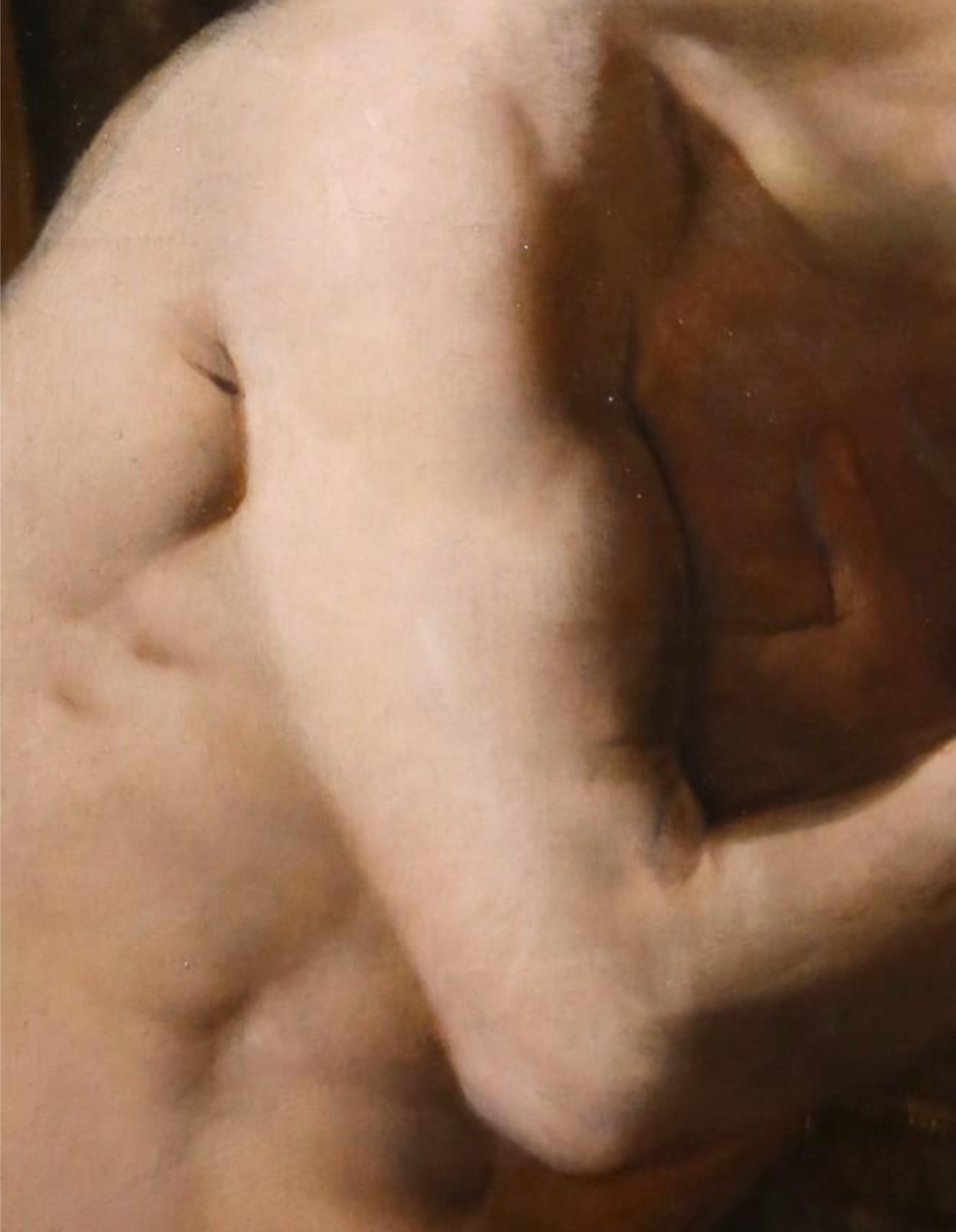
If the present painting can be dated to the years of close association between the two artists — that is, between the first decade of the 17th entury and 1614, when Commodi left Rome and entrusted the training of Pietro da Cortona to Ciarpi(5) a particular stylistic feature nonetheless allows us to attribute it with certainty to the hand of the younger painter, Baccio Ciarpi. When examining our Saint John the Baptist, one notices the use of dark, schematic brushstrokes intended to emphasise certain anatomical details of the saint, which stand in marked contrast to the overall naturalism. This technique is particularly visible in the outline of the right arm, in shadow up to the armpit, where three highly stylised folds can be discerned. It appears in the same area on the other arm, as well as, more subtly, in the folds painted on the abdomen and in the region of the elbow (ill. 2 and 3).

This characteristic, absent in Commodi, can be found in the aforementioned Miracle of Saint Benedict (one of the earliest works by the master from Barga, alongside the Death of Saint Benedict in Rome), particularly in the shaded details of the saint’s ear seen from behind (ill. 1).
This technique is even more evident in Ciarpi’s masterpiece, the Baptism of Constantine in San Silvestro, L’Aquila (ill. 4), whose dating is debated (perhaps 1617, certainly within the second decade of the century(6)). Similar brushstrokes can be observed there, notably in the nude body of Constantine, where these touches serve to define the arm and to create, in a synthetic manner, a fold beneath the armpit.
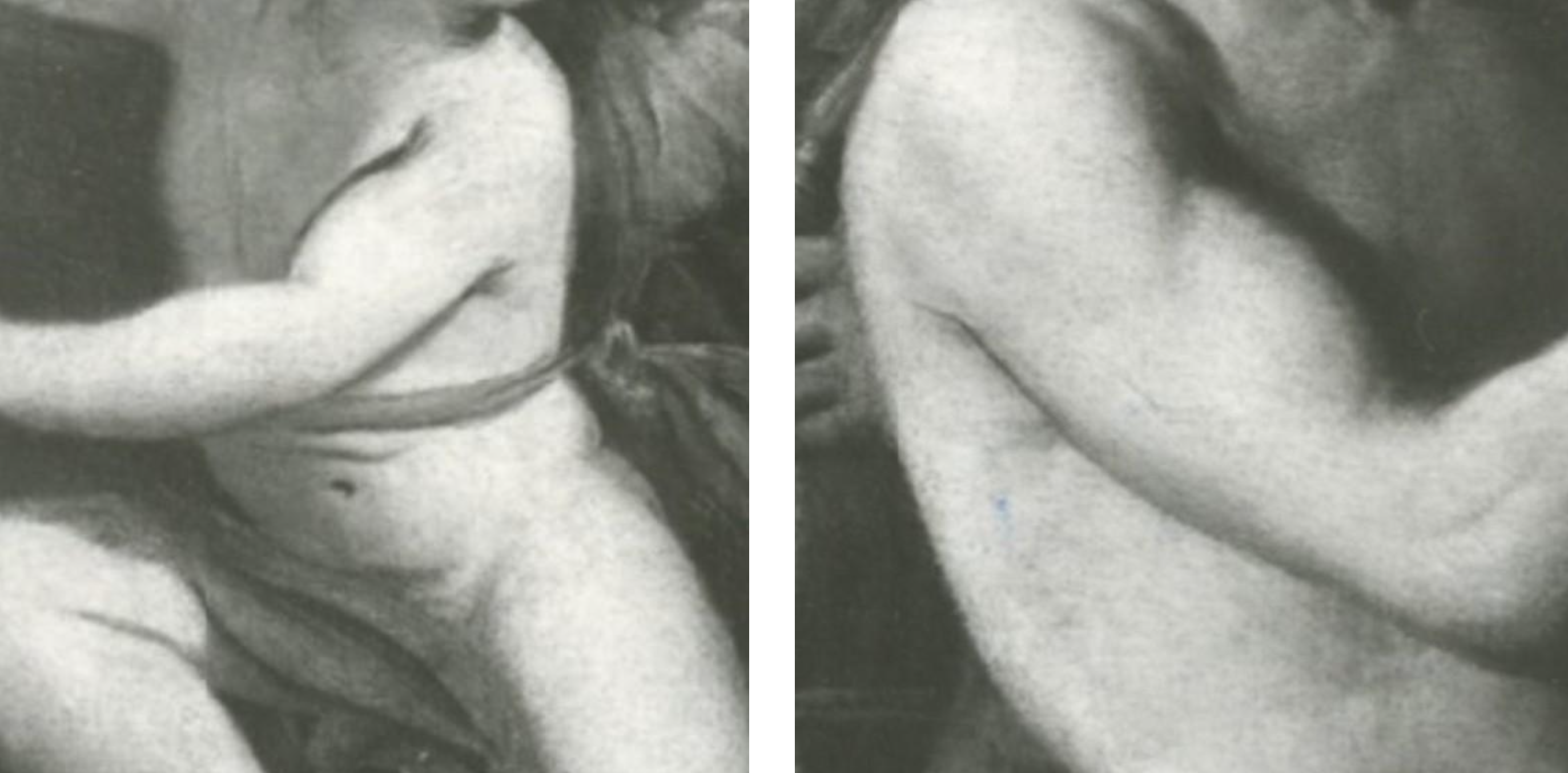
This manner of emphasising certain parts of the body, particularly noticeable in the treatment of flesh tones, does not appear ever to have been fully abandoned. It can in fact be found in the Virgin and Child with Saints in the Roman church of San Silvestro in Capite, datable to before 1622 but later than the Baptism of Constantine(7) : dark touches accentuate the arm of the Baptist in the foreground, that of the little angel placed just above, as well as the folds of the latter’s abdomen (ill. 5 and 6).
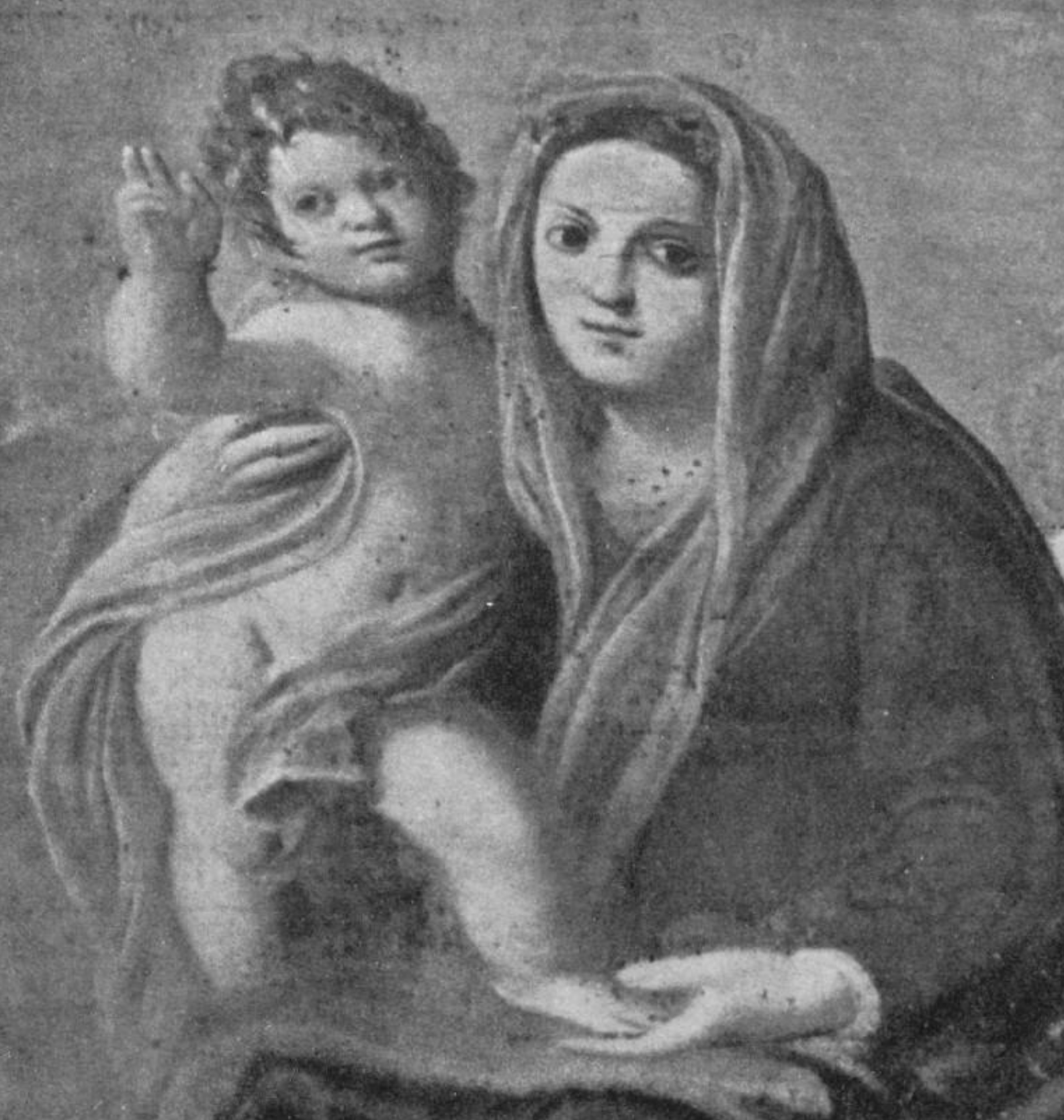
As for the physiognomy of the saint’s face in our painting, it seems to recall quite particularly that of the Madonna and Child in the SS. Annunziata in Barga (ill. 7), the artist’s native town—a work that can be placed in the painter’s full maturity, a period during which his activity appears to have been concentrated between L’Aquila and the Garfagnana(8).
At the painter’s death in November 1654, a detailed inventory of the possessions in his Roman apartment was drawn up. It records a large number of paintings, “many of which had certainly been painted by himself”(9). Among these works, one of the canvases described as being “in the salon of the first apartment, after going up two flights of stairs,” appears compatible with our painting: “another medium-sized picture, with a black frame heightened with a gilt band, representing Saint John the Baptist.”(10).
Federico Berti
(translated from the original study in Italian)
(1) F. Berti, Passignano nella Roma di Caravaggio, Florence, 2023
(2) F. Sricchia Santoro, « Baccio Ciarpi da Barga ‘maestro di Pietro da Cortona’ I », in Prospettiva, 1, 1975, p. 35
(3) “Commodi […] with whom Ciarpi’s earliest artistic production shares so many points in common that it raises problems of attribution”. (S. Prosperi Valenti Rodinò, “Ciarpi, Lorenzo Bartolomeo,” in Dizionario biografico degli italiani, 25, 1981, ad vocem)
(4) G. Papi, "La vera paternità della pala ritornata a San Severino dalla Pinacoteca di Brera: nuove riflessioni su Baccio Ciarpi", in Bollettino d’arte, 49, 2021, p. 92
(5) S. Prosperi Valenti Rodinò, op. cit.
(6) F. Sricchia Santoro, op. cit., p. 42
(7) F. Sricchia Santoro, "Baccio Ciarpi da Barga ‘maestro di Pietro da Cortona’ II", in Prospettiva, 2, 1975, p. 18
(8) S. Prosperi Valenti Rodinò, "Baccio Ciarpi", in Barga Medicea e le ‘enclaves’ fiorentine della Versilia e della Lunigiana, ed. C. Sodini, Florence, 1983
(9) F. Sricchia Santoro, "Baccio Ciarpi da Barga ‘maestro di Pietro da Cortona’ II", in Prospettiva, 2, 1975, p. 22
(10) A. Pescatori, "L’inventario della dimora di un pittore del seicento a Roma ", in Rivista d’arte, vol. XXXIII, 1958 [1960], p. 66