


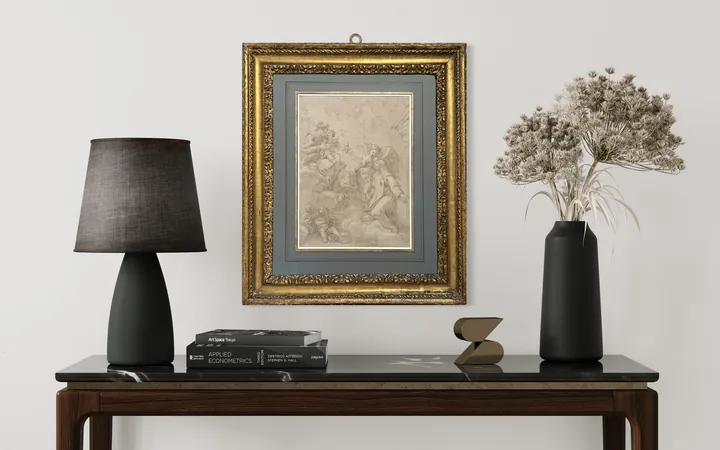

Giovanni Battista GAULLI, called Il BACICCIO
(Genoa, 1639 - Rome, 1709)
The Virgin and Child Appearing to Saint Mary Magdalene de' Pazzi (recto)
Study of drapery (verso)
Circa 1707
Pen and brown ink, brown wash over black chalk
13 7⁄16 × 9 13⁄16 in. (34,1 x 25 cm)
17th century Roman gilt frame - 23 7⁄16 × 21 3⁄16 in. (59.5 x 53.8 cm)
Artwork description
Provenance:
Sotheby’s London 5 juillet 2000, lot 130
Literature:
Francesco Petrucci (ed.), Pittura barocca romana, dal Cavalier d’Arpino a Fratel Pozzo ; La collezione Fagiolo, Milan, 1999, p. 70 (reproduced)
A drawing typical of Baciccio's late graphic work
This sheet, with its refined, highly finished workmanship, is perfectly representative of the late graphic work of Giovanni Battista Gaulli, called Baciccio. Originally from Genoa, he moved to Rome in 1657, where he worked with Bernini (1598-1680). Strongly influenced by the master's style, he quickly became one of the city's most prominent painters and established himself as a major player in the great Roman Baroque.
The ceiling of the nave of the Church of Gesù (ill.1), which he painted between 1672 and 1683, is undoubtedly his greatest masterpiece, and is emblematic of the great decorations of the late 17th century in Italy.
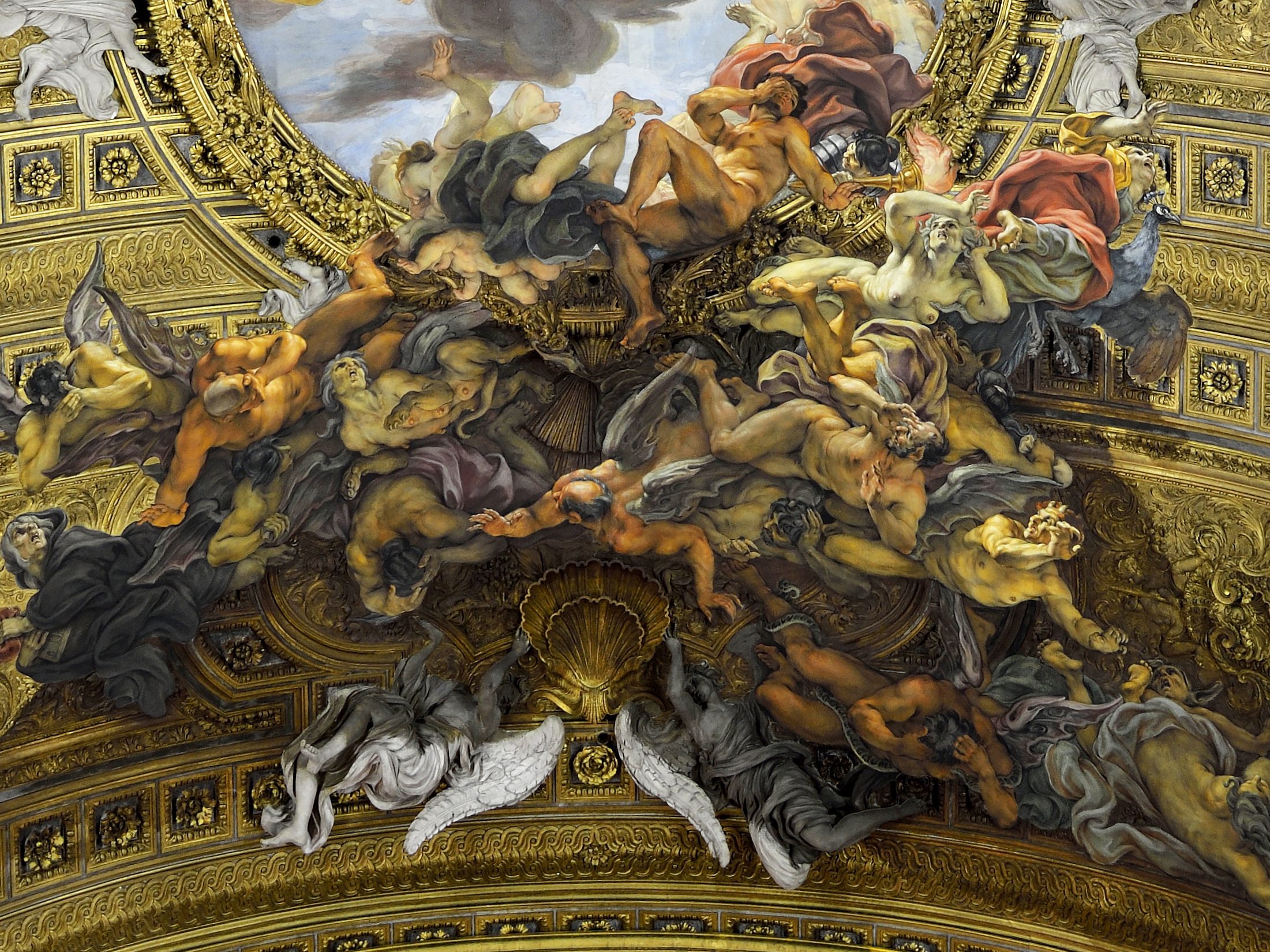
Triumph of the name of Jesus (detail)
Rome, ceiling of the Church of the Gesù
In Pittura barocca romana dal Cavalier d’Arpino a Fratel Pozzo(1), Francesco Petrucci proposes to compare our sheet with the preparatory drawing for the altarpiece The Virgin and Child Appearing to Saint Anthony of Padua (ill. 2), painted in 1707(2).
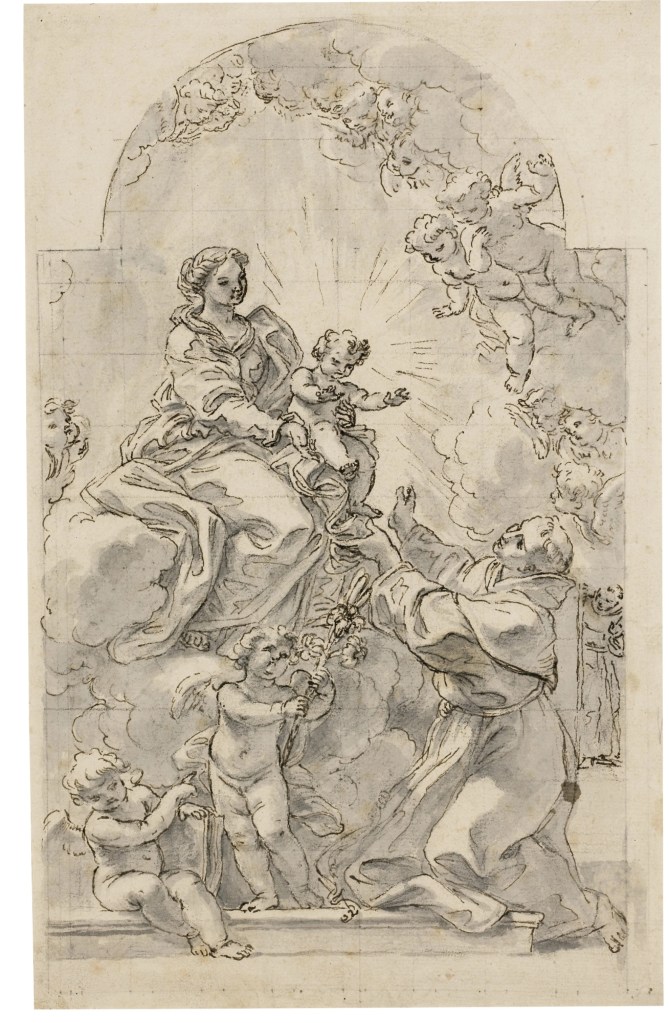
The Virgin and Child Appearing to Saint Anthony of Padua
Pen and ink and grey ink wash over black chalk lines - 34.1 x 25 cm
Private collection (former Ralph Holland collection)
This association seems obvious to us, given that the composition and style of the two sheets are so similar and typical of Baciccio's late production of graphic works, in which he favoured more finished drawings. The Virgin and Child tower over the figure of the saint and the putti while the miraculous scene is dominated by a flock of cherubs. Faithful to Bernini's aesthetic, Baciccio treats the figures and drapery as a vibrant, dancing mass articulated around a constrained space structured by the cloud mass. The whole is rendered with a precise, acute pen, enlivened by a subtle play of light created by a delicately applied wash.
Note the difference in treatment between the two sheets: in ours, the cloud of putti is barely sketched (ill. 3), creating a strong contrast with the rest of the composition, which is very detailed. This interesting technique reinforces the miraculous and intangible nature of the apparition.
A drawing closely related to Baciccio's final painting
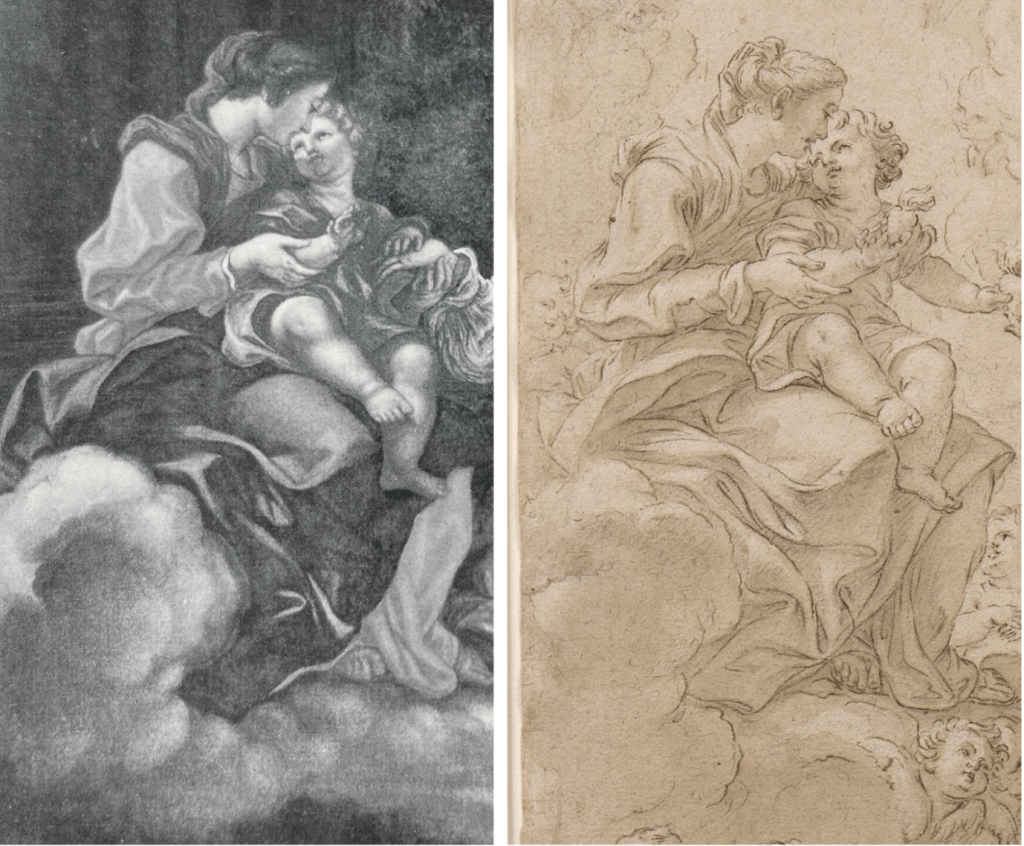
Our drawing can be connected to the last painting by the artist in 1709, The Mystical Marriage of Saint Catherine (ill. 3).
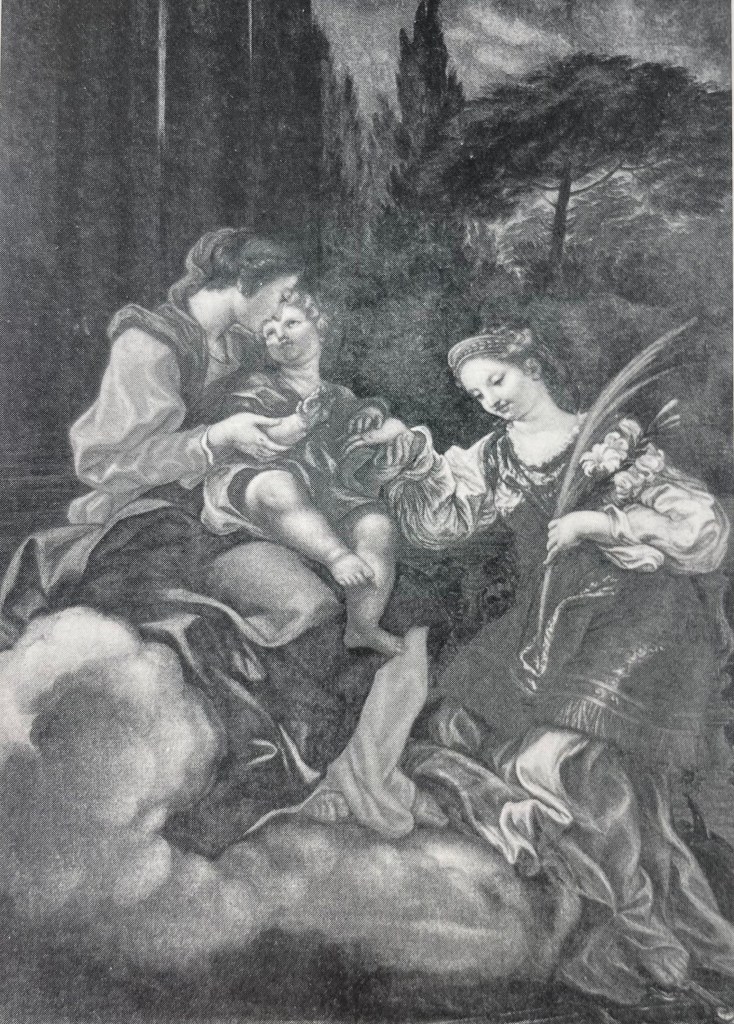
The Mystical Marriage of Saint Catherine
Oil on canvas
Location unknown
Their compositions are very similar, and the groups of the Virgin and Child are almost identical (ill. 4), so much so that it is highly likely that Baciccio used our sheet to design this painting.
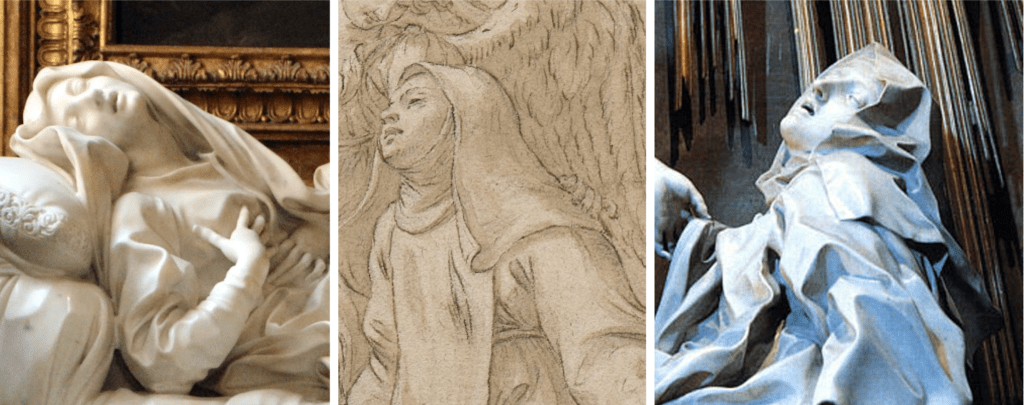
The ecstatic figure of the nun, with her eyes closed and her head slightly tilted back, is still very much influenced by the expression of the figure of Blessed Ludovica Albertoni and that of Saint Teresa (ill. 5) sculpted by Bernini.
A re-identified subject
Although our sheet initially appeared on the art market as a representation of Saint Catherine of Siena, its iconography prompts us to reconsider the saint's identity. Firstly, none of her traditional attributes are present: There is no gold ring, no crown of thorns, no skull, no book, no lily, no rosary, no stigmata. What's more, the saint in our drawing wears the monastic scapular, typical of Carmelites, whereas Saint Catherine of Siena is a Dominican.
We therefore hypothesise that our sheet depicts Mary Magdalene de' Pazzi, a Florentine Carmelite nun from the late 16th century who was often portrayed by Baroque painters. Indeed, the Sacred Heart that the nun receives from the Virgin, through the intercession of an angel, is one of the attributes of this saint, canonised in 1669 by Pope Clement IX Rospigliosi.
Framing and condition report
Our sheet is mounted in the manner of Mariette and presented in a very fine Roman frame from the 17th century. Our drawing is in an excellent state of conservation and has no notable defects.

(1) Francesco Petrucci (ed.), Pittura barocca romana, dal Cavalier d’Arpino a Fratel Pozzo ; La collezione Fagiolo, Milan, 1999, p. 70
(2) Robert Enggass, The Painting of Baciccio, Giovanni Battista Gaulli, 1639-1709, Pennsylvania, 1964, pp. 127-128.
Today housed in the church of Monte Calvario in Imperia, the altarpiece was originally in the church of the SS. Annunziata in Porto San Maurizio, which was demolished by an earthquake in 1887. It was painted in Rome and Gaulli was paid for the commission in July 1707.