

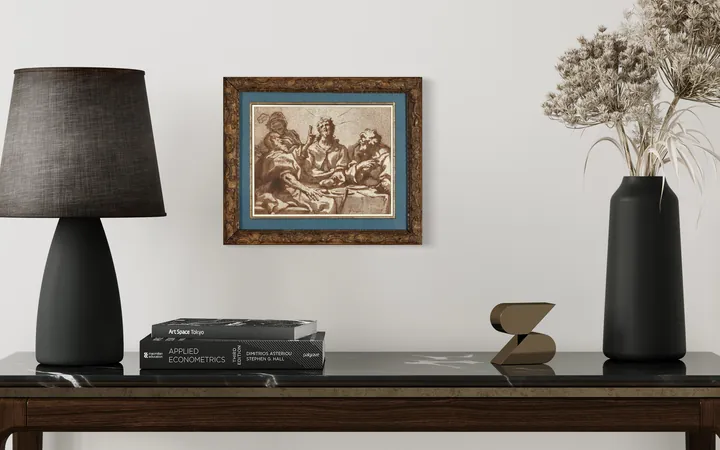
Domenico PIOLA
(Genoa, 1627-1703)
The Supper at Emmaus
Pierre noire, plume et encre brune, lavis brun, gouache blanche
7 ⁹⁄₃₂ × 9 ⁷⁄₁₆ in (18,5 x 24 cm)
Inscribed “Guercino”
Bérain frame, Louis XIV period - 11 3/8 × 13 1/2 in. (29 x 34,4 cm)
Artwork description
A dynamic drawing of a scene captured from life
In the’Gospel according to Luke (Lk 24:13–35), the risen Christ appears on the road to Emmaus to two disciples who, troubled by his recent death, fail to recognize him. The two men offer him hospitality and share a meal with him. “He took the bread, said the blessing, broke it, and gave it to them. Then their eyes were opened and they recognized him… It was the Lord.” It is precisely this moment that Domenico Piola chooses to depict in the present sheet: the two astonished disciples have just recognized the Messiah, bathed in a halo of light, and suddenly become aware of the miracle of his resurrection.
In keeping with the aesthetics of Genoese Baroque, the entire treatment of the drawing conveys a sense of movement and agitation, enhancing the dramatic impact of the scene. The composition, built around the figure of Christ, is structured by a strong chiaroscuro created through the contrast between the areas of the paper darkened by wash and the passages left in reserve and heightened with white gouache. This restless, almost dancing quality is emphasized by the vigorous rendering of the figures: heavy, undulating draperies, bold foreshortenings of the hands, and beards and hair animated with a lively and precise pen. The intense dramatic effect is heightened by the tight framing on the protagonists, which lends them a certain monumentality while making their emotions all the more immediate and tangible, as if seized in the moment.
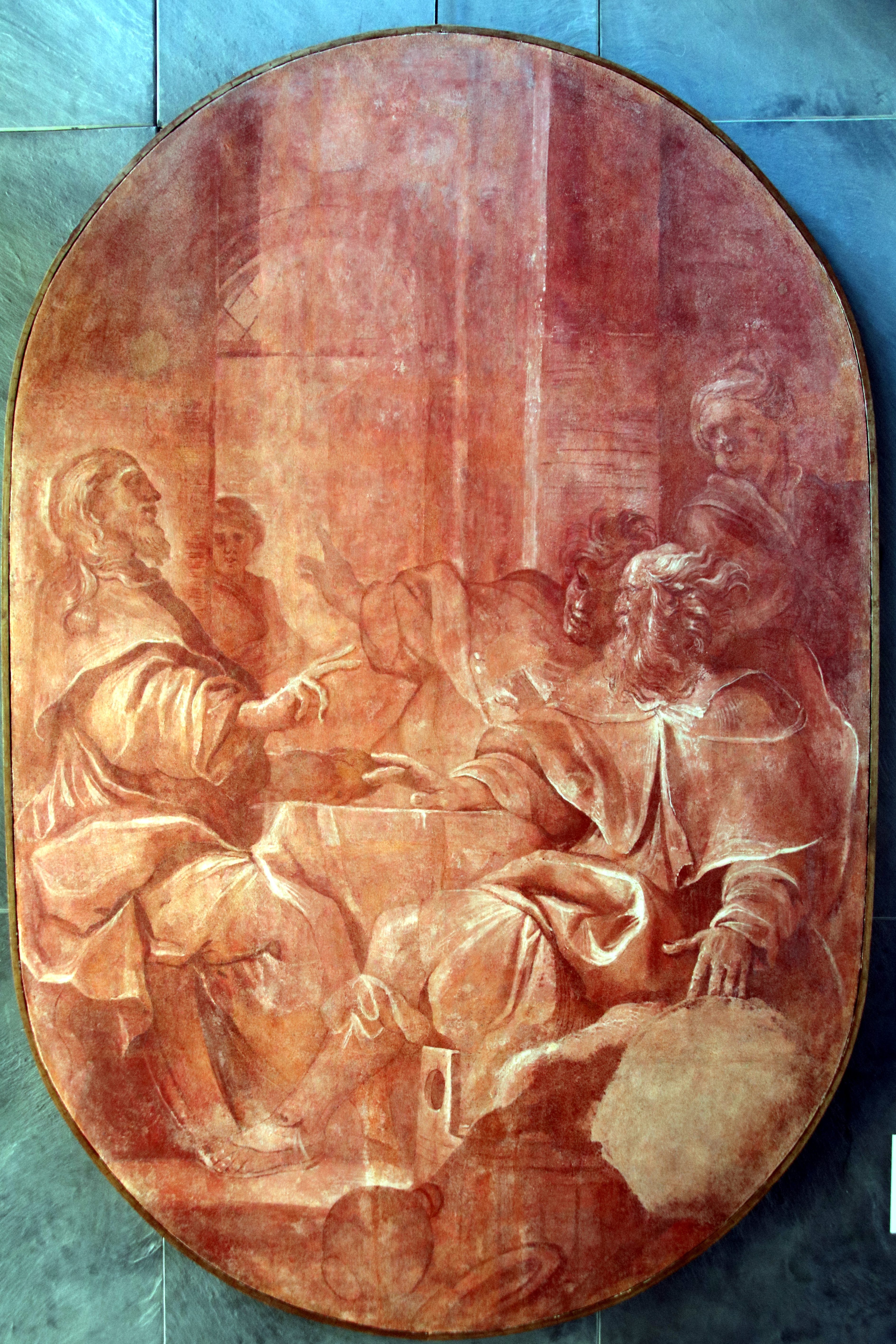
Although the present sheet cannot be directly linked to a known work by the artist, Piola did paint a grisaille of the Supper at Emmaus (ill. 1) for the church of Santa Maria in Passione in Genoa(1). While this composition differs from that of our drawing, it displays similar lighting effects and an overall comparable treatment.
Domenico Piola, a key figure of the Genoese Baroque
Contrary to an old inscription attributing our sheet to Guercino (1591–1666), its authorship must in fact be sought in another great master of the Baroque: Domenico Piola, the central figure of 17th siècle. On y reconnaît, sans conteste, son style graphique typique et personnel, empreint du naturalisme de Giovanni Benedetto Castiglione (1609-1664) et du maniérisme lombard tardif de Valerio Castello (1624-1659). Issu d’une importante famille d'artistes, il se forme d’abord auprès de son frère Pellegro (1617-1640) puis de Giovanni Domenico Cappellino(2) . He later formed a close friendship with Valerio Castello, and upon the latter’s death in 1659, Piola emerged as the true leader of Genoese painting. He subsequently directed a large family workshop, the “Casa Piola” , through which he conceived and carried out the most prestigious decorative commissions in the city.
A prolific and virtuoso draughtsman, “his mastery of a vast iconographic repertoire and his ability to provide preparatory studies for every kind of support (…) secured him an almost exclusive monopoly over artistic production in Genoa during the second half of the 17th entury, which explains why his manner spread throughout all the local workshops”(3).
Framing and condition report
Our sheet is mounted with a false margin, presented in a mounting in the style of Mariette, and framed in an elegant Louis XIV-period Bérain frame. The sheet is in good condition and shows no notable defects.
(1) The fresco is now transferred to canvas and preserved in the Museo di Sant’Agostino.
(2) C. G. Ratti, Delle Vite de' pittori, scultori, ed architetti genovesi e dei forestieri che in Genova hanno operato, Genoa, 1769, reprint Genoa, 1965 et Bologna, 1969, II, pp. 29-51
(3) F. Mancini, Dessins génois XVIe-XVIIIe siècle - Musée du Louvre, Département des arts graphiques, Paris, 2017, pp. 19-20