

Circle of Nicolò DELL'ABATE
(Modena, 1509 – Fontainebleau, 1571)
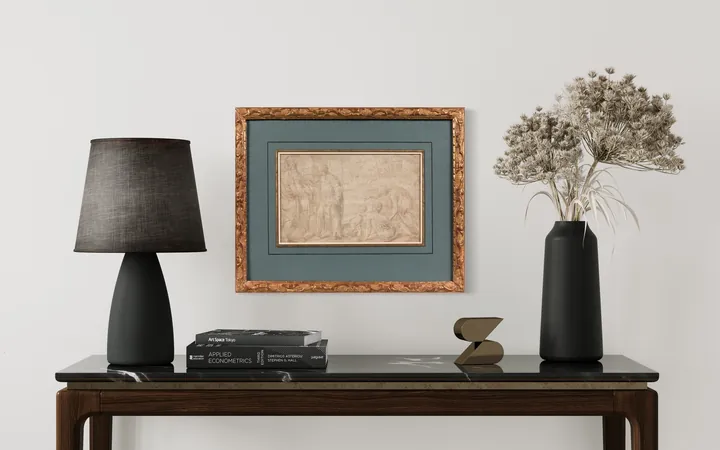
Recto: Narrative scene with several figures
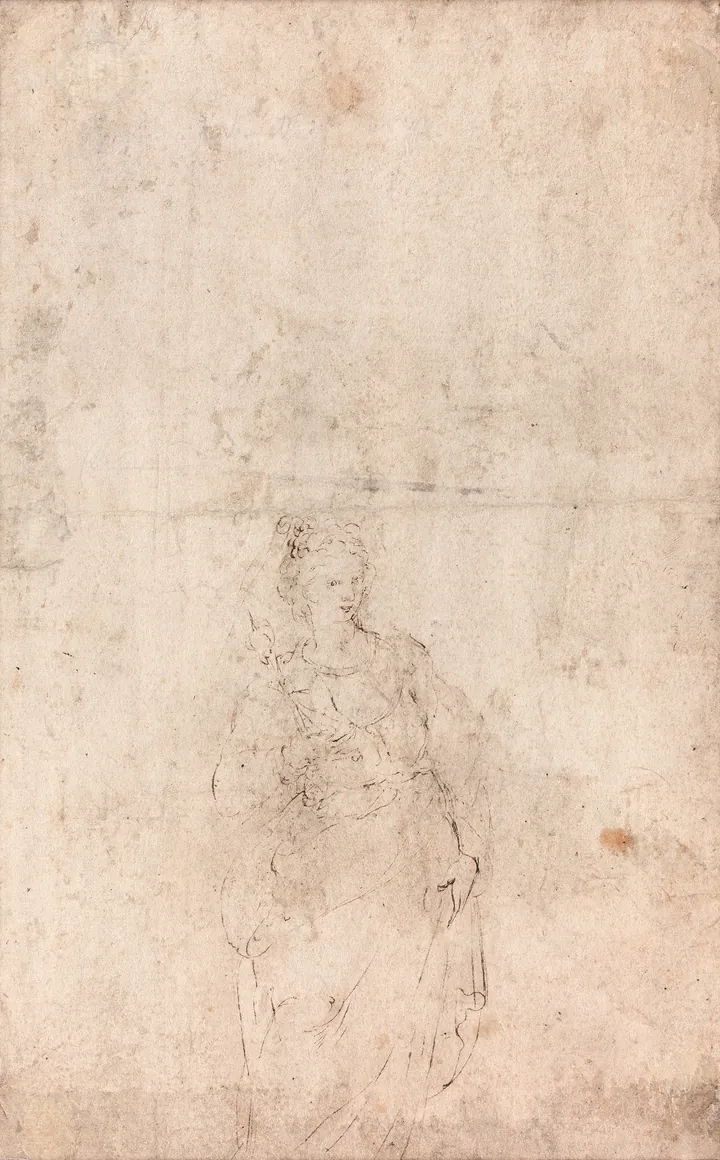
Verso: Female figure
7 ⁷⁄₈ × 12 ³⁄₈ in. (20 × 31.5 cm)
Recto: Pen and brown ink, brown wash over black chalk
Verso: Pen and brown ink
Watermark: Crossbow within a circle, close to Briquet 749 (Lucca, 1548)
Louis XIV period Bérain frame – 16 ¹⁄₈ × 20 ¹⁄₄ in. (41 x 51.5 cm)
Artwork description
Provenance:
Marquis Charles de Valori (Paris, 1820–1883), his mark at lower right on the recto (L. 2500)
A rare and enigmatic subject, open to interpretation
The recto of the sheet presents a narrative scene which, taken out of context, is difficult to decipher. At right, a young woman, seated and half-nude, appears to be addressed by a young child and a young man who points toward three men conversing on the left side of the composition. Dressed in long cloaks, they stand discussing at the foot of what seems to be a portico. In the distance, two antique architectural elements are visible: a pyramid and a circular temple, loosely recalling the Pyramid of Caius Cestius and the Temple of Vesta. Nearby, barely discernible figures appear to disembark onto the shore from a ship moored at the quay.
Although the subject is rare and unusual, and no obvious biblical, historical, or mythological episode presents itself, a plausible line of interpretation leads us to Heliodorus’s Aethiopica (3rd–4th century), and more specifically to the episode of Theagenes and Chariclea on the Island of the Shepherds. In the sixteenth century—and particularly at the French court—such erudite subjects drawn from ancient literature enjoyed considerable popularity. Several elements of the composition support this hypothesis: the antique architecture suggests a distant historical setting; the presence of the ship suitably evokes an episode taking place on an island; and the appearance of the three men on the left, especially the one wearing a broad hat, is not incompatible with that of shepherds. In this reading, the group on the right would represent the reunion of Theagenes and Chariclea, symbolically united by the presence of the small Cupid accompanying the young woman.
A drawing to be placed within the circle of Nicolò dell’Abate
Stylistically, the drawing exhibits several features characteristic of the first School of Fontainebleau, and in particular of Nicolò dell’Abate. Many of his graphic habits are present: elongated index and middle fingers, almost mandibular in form; sharply angular breaks at the wrist; larval, barely sketched feet; and typical physiognomies, especially those of the young man and the woman on the verso. Moreover, the overall handling displays the freedom and graceful softness of line inherited from Parmigianino, evident notably in the depiction of the three “shepherds,” and characteristic of the master from Modena. However, the drawing lacks the fluidity and assurance associated with Nicolò himself; it is more likely to be the work of one of his collaborators or an artist within his close circle.
If we know that he worked alongside his son, Giulio Camillo, and probably continued to collaborate with former members of Primaticcio’s workshop, we nonetheless lack drawings that can be attributed to these artists with certainty, which makes it impossible to distinguish their respective graphic identities with confidence. It is, however, interesting to note the very strong stylistic proximity between our sheet and a drawing (ill. 1) preparatory for a fresco in the decoration of the Château d’Ancy-le-Franc(1) . Indeed, one finds the same synthetic interpretation of the manner of the master from Modena. The authorship of this sheet, still debated, has been attributed either to a member of Primaticcio’s workshop: sometimes the anonymous Master of Flora (documented c. 1540–1560), sometimes Ruggiero de Ruggieri (documented between 1540 and 1596), a painter of Bolognese origin recruited at Fontainebleau shortly after Nicolò dell’Abate.

Paris, Musée du Louvre (inv. 5856)
(1) M. Bélime-Droguet, Les décors peints du château d’Ancy-le-Franc (v. 1550-v. 1630), Besançon, 2016, p. 123