
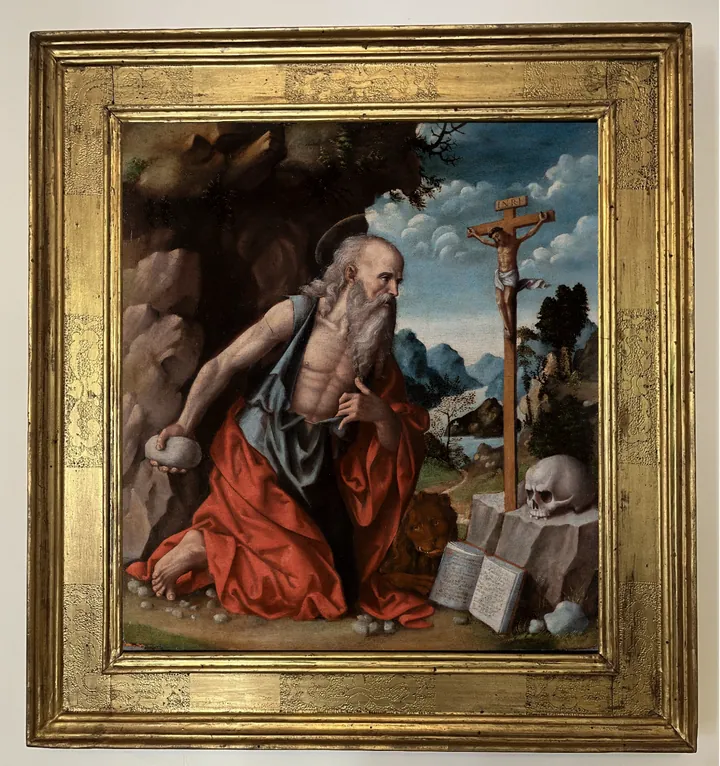


Giovanni Francesco CAROTO
(Mozzanica?- Bergamo, circa 1475-78 – Verona, 1555)
Penitent Saint Jerome
Circa 1515-1518
Oil on poplar panel
22 1⁄4 × 19 7⁄8 in. (56,5 x 50,5 cm)
Gilt a casseta frame - 28 3⁄4 × 26 1⁄4 in. (73 x 66,8 cm)
Provenance:
- Collection from the Brescia region before 1859 (customs stamps on the back of the panel)
- More recently, in a private collection in Hauts-de-France
We would like to thank Professor Mauro Lucco for writing the following study after having attributed our painting with certainty to Giovanni Francesco Caroto. A well known specialist in Venetian and Emilian painting, he has published a number of monographs that have become standard references (Giovanni Bellini, Andrea Mantegna, Giorgione, Bartolomeo Montagna, Antonello da Messina, Dosso Dossi, etc.).
The original study, in Italian, signed and dated by Professor Mauro Lucco, is available on request.
Artwork study by Mauro Lucco
Our painting appeared as an unattributed work on the French art market in 2022. It is in an excellent state of conservation, with no real gaps in the painted surface and no major missing parts, as shown in the photo taken after the cleaning (ill. 1) carried out by Cinzia Pasquali in the Arcanes studio in Paris (restoration report available on request).

This very good conservation is due not only to the great care taken by the artist to ensure the work's durability, but also to the preparation of the back of the panel (ill. 2) with a dark brown primer to prevent sagging due to the absorption of excess moisture. In small areas where this preparation has come off, the characteristic fibre of poplar wood is clearly visible.

Two red wax seals (ill. 3) can also be seen on the back of the panel: on the one at the top left, the circular inscription around the double-headed Habsburg eagle can be read without difficulty: "Provincia di Brescia I.R. Delegazione"; the second, more worn, at the bottom right, near the label bearing the number 43 (probably a collector's label) still leaves the inscription "Boll....d'Espor..../Bresc..../...." visible. Both obviously refer to the customs office responsible for exporting works of art from this province. However, the reference to the "I[mperial] R[egia] Delegazione" and the presence of the double-headed eagle indicate that the operation to which they refer predates 1859. In that year, following the Second War of Independence, the part of the Lombard-Venetian Kingdom beyond the Adige that had previously been under the authority of the Imperial Government in Vienna came under the jurisdiction of the Kingdom of Piedmont-Sardinia, ruled by the House of Savoy.
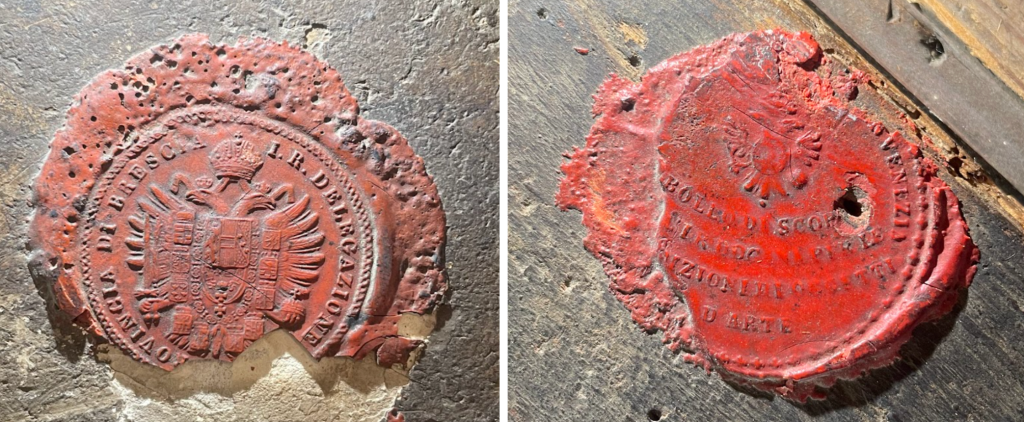
The position of the seal at the bottom, partially cut, and a few small splinters of wood on the right-hand side of the painting (the left-hand side when the work is viewed from the back) suggest that the panel has been trimmed slightly at these edges. However, the balance of the composition shows that, if such an operation took place, it probably only involved a few millimetres. This is all the more plausible given that the two lighter vertical strips, corresponding to crosspieces removed later to keep the panel straight, are slightly asymmetrical, which would indicate a cut of no more than 4 or 5 mm.
Photos of the figurative part of the painting before and after cleaning, as well as its final appearance, show that it is intact and perfectly legible in its stylistic characteristics. An X-ray taken during the restoration shows that the saint was originally in perfect profile before being slightly modified into his current pose, a very accentuated three-quarter view.
The network of complex, zigzagging folds in the hermit's drapery is clearly reminiscent of the models inspired by Mantegna (1431-1506) painted by the Veronese Francesco Bonsignori (1460-1519), during his stay in Mantua from 1477 (as indicated by a document found by Stefano L'Occaso(1)). This stay did not prevent him from sending some of his major works to Verona. This parallel is particularly evident in the comparison (unfortunately only possible today through photography) with the Saint Sebastian in the Kaiser-Friedrich-Museum in Berlin, dated 1485 and destroyed during the war in 1945 (ill. 4).
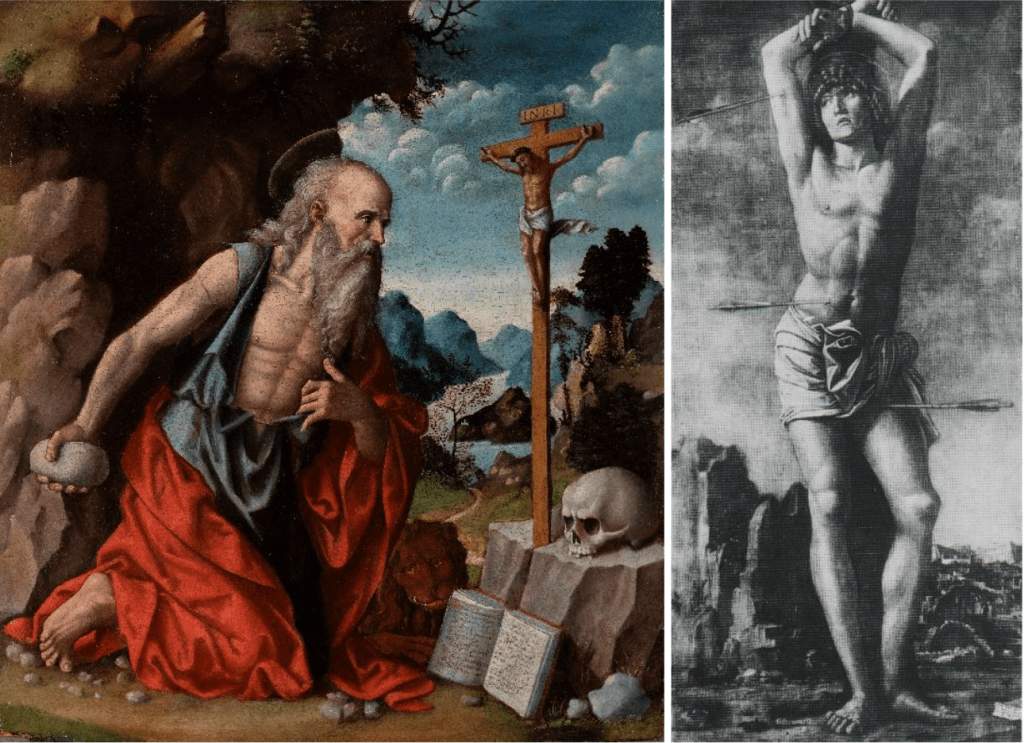
It's true that, although Verona and Mantua are contiguous territories, making it easier to travel between the two cities, the presence in the Gonzaga city of the greatest painter of the time, Andrea Mantegna, made it much more attractive than the more populous Verona. Other details also point to this origin: the rocks jutting out like decayed teeth (ill. 5), to the left of the saint, are reminiscent of those in the Madonna of the Caves from the Uffizi, perhaps reinterpreted in a simpler and more prosaic manner by Antonio da Pavia (active between 1500 and 1514), as in the Nativity with Saint Anthony Abbot and Saint Sebastian, formerly in the Ostiglia Hospital and now in the Diocesan Museum in Mantua, and dated to around 1506-1510(2).

and the Nativity with Saint Anthony Abbot and Saint Sebastian by Antonio da Pavia (details)
The landscape, which Manzoni might describe as "all sinuosities and gulfs", with mounds emerging from the water and a small frail tree indicating depth, can be found in other Mantuan works still influenced by Mantegna: for example, in a painting probably by Fermo Ghisoni (ill. 6), kept at the Albertina Academy of Fine Arts in Turin (inv. 135) and painted after the engraving of the Madonna of Humility by the great master around the middle of the century.

If these details point to a rather unambiguous cultural origin, we will have to look among the Veronese artists who stayed in Mantua for more or less time, during the chronological period deduced from the previous observations. The fact that there are very few of them, no more than three or four(3)and the particular morphology of the rocks, typical of Mantua until the completion of the Redondesco altarpiece(4)point to a single possible name: Giovanni Francesco Caroto.
According to Giorgio Vasari(5), in fact, "after learning the first rudiments of letters, having an inclination for painting, he began to learn it from Liberale da Verona, promising to reward him for his efforts. [...] A few years later, having become more discerning with age, he saw the works of Andrea Mantegna in Verona, and finding, as was indeed the case, that they were of a different style and better than those of his master, he arranged, with the agreement of his father and the agreement of Liberale, to become attached to Mantegna. Thus, when he left for Mantua and was placed under his tutelage, he acquired so much skill in a short space of time that Andrea sent out works by him as if they were by his own hand...".
Of course, no one can believe the literal veracity of the story that Mantegna, who preferred to refuse to paint rather than let imperfect pictures leave his studio, began selling fake works by Caroto. However, nothing can be said against the essential fact: Caroto's presence in Mantua. As proof, his altarpieces of Redondesco and Santa Maria della Carità remain in the Gonzaga city today.
A closer look at the damaged altarpiece in the Carità shows that the profile of Saint Bovo is very similar to that of our Saint Jerome (ill. 7), and even more so to the first idea, later modified, revealed by the X-ray. Mutatis mutandis, in the transformation of a male face into a female one, the quasi-profile of our Saint Jerome is found in a Madonna and Child (ill. 8) acquired in 2016 by the Palazzo Ducale Museum in Mantua under the name of Caroto, although it was later reattributed to Bonsignori, between 1510 and 1515. However, if we consider the stylistic difference with the altarpiece in the chapel of San Biagio in the church of Santi Nazaro e Celso in Verona, begun in 1514 and completed before 1519, we must inevitably conclude that the first attribution was more justified.


These physiognomies are also to be found, in my opinion, in one of the major works of the artist's career, the Lamentation over the Dead Christ (ill. 10), formerly in the Fontana collection in Turin, signed on the reverse and dated 1515: an essential document for a crucial moment in his career, that of his service at the court of the Palaeologus in Casale Monferrato. In reality, we know nothing precise about the circumstances of her employment. It has been speculated that it may have been facilitated by the Veronese sculptor Matteo Sanmicheli (active until 1528), who was present at the Palaeologus court between 1510 and 1517 and was a cousin of the more famous architect Michele (1484-1559), who may also have recommended him to the Marquis, or by Antonio Maria Visconte himself, Caroto's Milanese patron and protector.
The first mention of our artist in Casale dates from 12 July 1516 and concerns a donation of land by William IX, of which he was the beneficiary. Apart from other considerations about the profession and role of painters, this implies that the two men had known each other for some time. Given that the Lamentation over the Dead Christalready painted at the time, is probably what remains of the decoration of William IX's private chapel, it is not unreasonable to think that Caroto arrived in the city as early as 1514, almost as an immediate replacement for Macrino d'Alba (circa 1460-1513). In fact, there is no trace of this painter after his Madonna and Child from a private collection in Turin, dated 21 October 1513, which would have disappeared at that time.
The signed altarpiece with Saint Sebastian, which is still in the church of Santo Stefano, its original location, also belongs to the same Casale period. In addition to other cultural influences, it features the detail of a little finger stretched outwards, as in our Saint Jerome (ill. 9).
But I believe that beyond the occasional coincidence of motifs, we must recognise the very strong kinship that exists between our painting and the Lamentation over the Dead Christ ex-Fontana (ill. 10): the arrangement of the folds, the deep tonality of the palette, the similarity of the gestures, the volumetric power of the forms contrasted by the nervousness of the fingers form a genuine encounter on common ground. Nor would I want to waste any more time enumerating other small "Morellian" details, such as the rounded shape of the fingernails and toenails, which recurs in characteristic fashion throughout Caroto's work. What is more important, however, is to emphasise that, in a seemingly discontinuous career marked by numerous breaks, the absolute equivalence of style with the ex-Fontana painting of 1515 also places our painting in the artist's happiest period, at the court of the Palaeologus of Casale Monferrato, which has yet to be explored in greater depth to reveal, if possible, something more about this remarkable and elusive artist.
All in all, this is a very important discovery, which also makes it possible to better assess Caroto's importance in the context of Veronese painting of the 16th century, which, at least until the last monographic exhibition in 2022, did not yet seem to be well established.
Mauro Lucco
(translated from the original study in Italian)
Painted during the artist's stay in Casale Monferrato between 1514 and 1518, while in the service of William IX Paleologus, our panel joins the only two known works from this period.
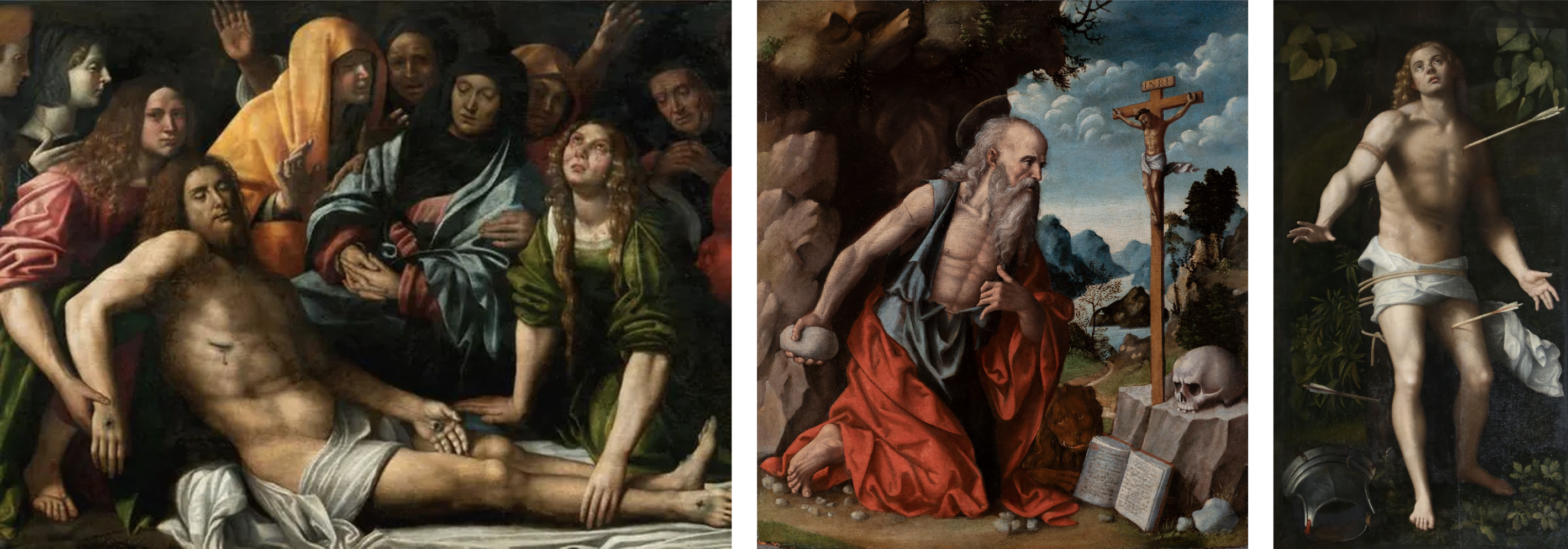
(Casale, church of Santo Stefano)
(1) S. L'Occaso, Fonti archivistiche per le arti a Mantova tra Medioevo e tutta Rinascimento (1382-1459), Mantua, 2005, pp. 127, 129 note 7
(2) M. Danieli, in Mantegna a Mantova, 1460-1506, exhibition catalogue, Milan, 2006, pp. 144-145
(3) S. L’Occaso, Pittura a Mantova nel Quattrocento, Mantua, 2019, pp. 189-206
(4) Painted by Giovanni Francesco Caroto in Mantua, it depicts Christ with the cross between two saints (see Danieli, op. cit., pp. 194-195)
(5) Le vite de’ più eccellenti Pittori, Scultori ed Architettori, Florence 1568, ed. Milanesi, vol. V, Florence, 1906, p. 280