


The MASTER of MARTYRDOMS
(active in Naples in the first half of the 17th century)
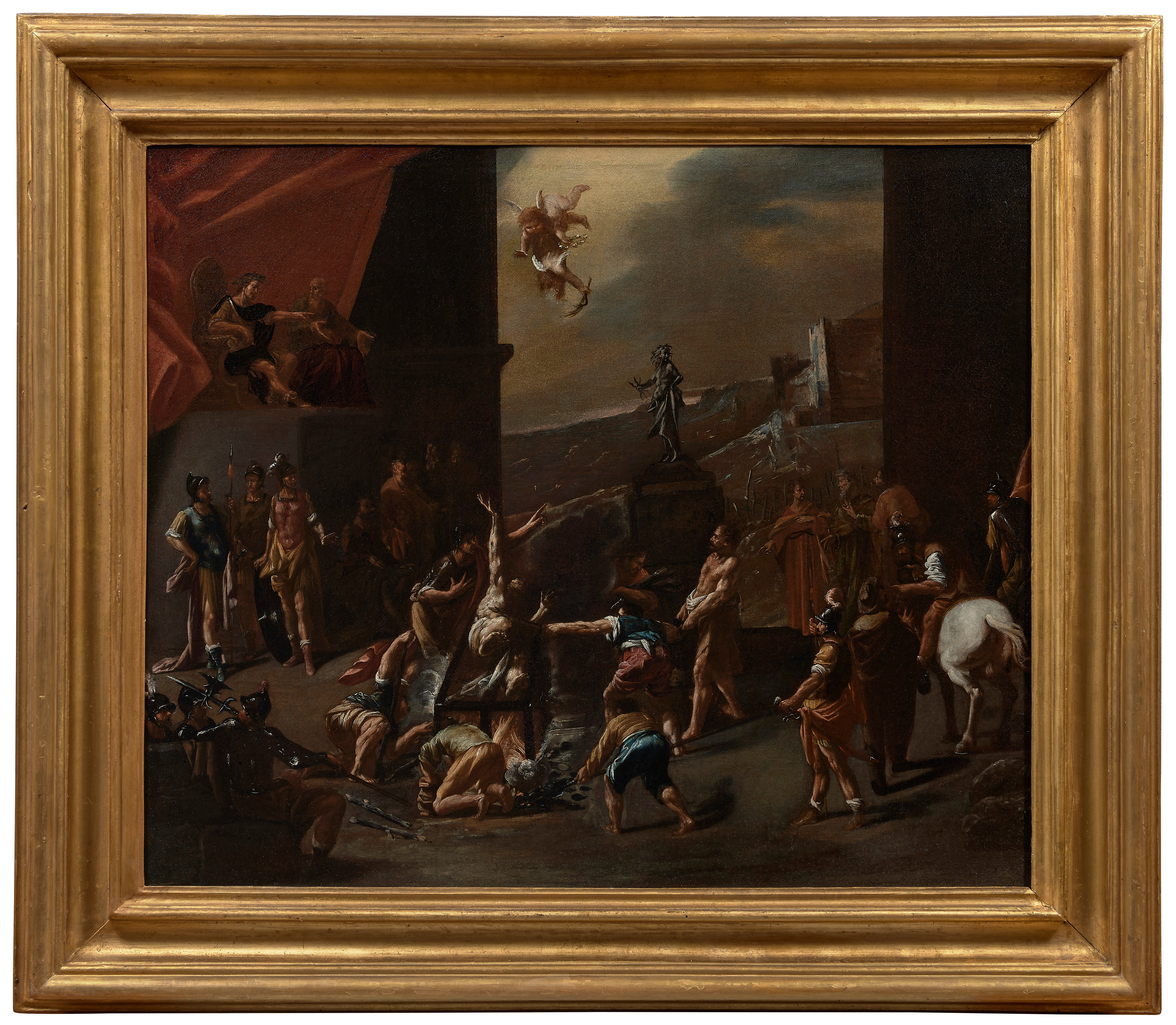
The Martyrdom of Saint Lawrence
Oil on canvas - 24 5⁄8 × 29 15⁄16 in. (62.5 x 76 cm)
Italian 17th century Italian gilt frame - 31 7⁄8 × 37 in. (80.8 x 94 cm)
We would like to warmly thank Professor Pierluigi Leone de Castris for confirming the attribution of this painting. He is an art historian and a leading specialist in Neapolitan painting, to whom we owe the first studies on our artist.
Artwork description
Comparative bibliography:
- P. Leone de Castris, "Maestro dei martiri", in Il Barocco a Lecce e nel Salento, exhibition catalogue edited by A. Cassiano, Lecce 1995, p. 64
- G. Porzio, "Martirio di San Stefano", in Il Museo Diocesano di Napoli. Percorsi di fede e arte, catalogue edited by Pierluigi Leone de Castris, Naples 2008, pp. 134-135, no. 42
A rediscovered work by a rare artist, yet to be fully explored
Our painting is a discovery: acquired as anonymous work, we were able to trace it back to the Master of Martyrdoms with certainty, thanks to the help of Professor Pierluigi Leone de Castris, the first person to have studied this Neapolitan artist, who was active in the first half of the 17th century.
His known body of work, which is very limited, consists mainly of scenes of martyrdom, from which he takes his conventional name. Although this master has yet to be identified, we do know that he belongs to the same group of artists as Filippo d'Angeli (1600-1660), François de Nomé known as Monsù Desiderio (circa 1593 - after 1623) (ill. 1) and Cornelio Brusco (1606-1620), whose pupil he undoubtedly was(1). He shares many stylistic similarities with them: a certain taste for tenebrism, a lively touch that is often visible and figures with exaggeratedly elongated proportions, still marked by mannerism.
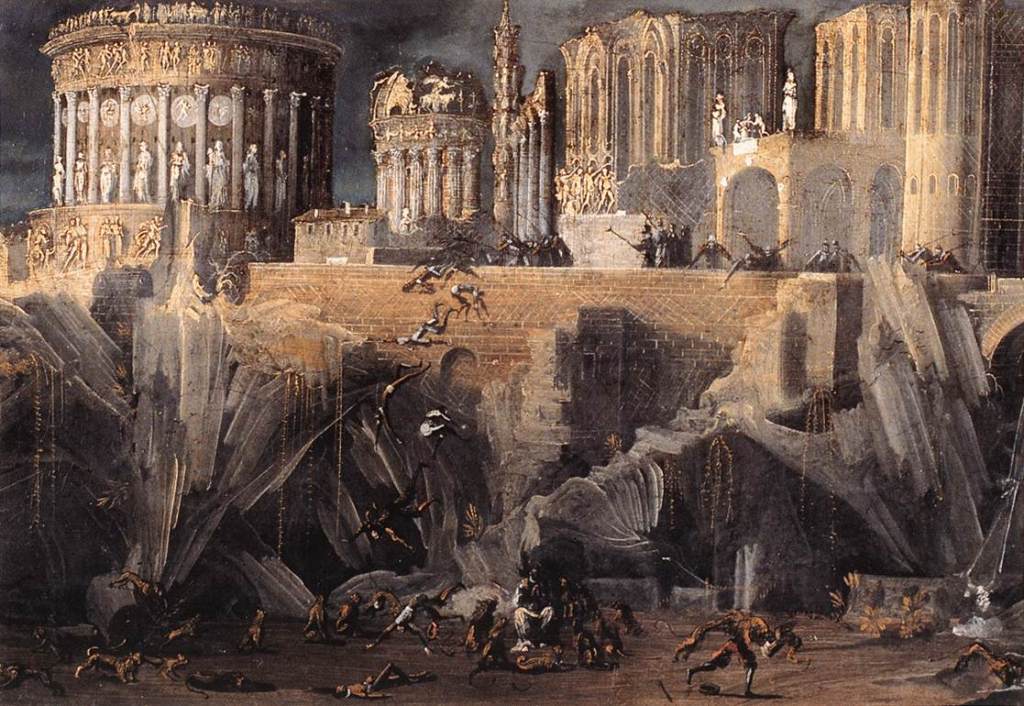
Fantastic architectural view
Oil on canvas
Metz, Cour d'or Museum
A violent subject treated with vigour
In 258, the deacon Lorenzo of Rome was martyred for having distributed to the poor the riches of the Church coveted by the emperor Valerian. Sentenced by the Prefect of Rome to burn for a long time on a grill, Saint Lawrence miraculously remained unaffected by pain. According to Jacobus de Voragine, he even taunted his executioner by saying: "Well, you've roasted me enough on this side; turn me over to the other side, after which I'll be done to perfection!”(2).
This astonishing painting, with its spirited treatment, characterised by a lively brushwork applied in visible, nervous strokes, captures all the violence of the subject. The artist depicts the scene at its climax: on the point of succumbing, Lorenzo, depicted in a striking foreshortening and bathed in violent chiaroscuro, reaches up to heaven (ill. 2) to receive the crown and palm of martyrdom from two intertwined angels.
His executioners, busy and contorted around the tortured saint, while other scattered groups of soldiers frame the scene. The ensemble is completed by worrying figures in togas, whose almost ghostly presence is barely suggested by a few lively brushstrokes (a process found in many of François de Nomé's paintings). At the top left of the composition, the Prefect, accompanied by a councillor, orders the punishment. He is surmounted by a large red curtain to which the horseman's standard responds; this theatrical effect reinforces the dramatism of the martyrdom.
Related works
Although the majority of the Master of Martyrdoms’ body of work has yet to be discovered, his few known works have enabled us to attribute our painting to him with certainty, given his distinctive and easily identifiable stylistic characteristics.
Two paintings in particular stand out: the first (ill. 3) from the Diocesan Museum of Naples, published in 2008(3), and the second (ill. 4), from a private collection, also a martyrdom of Saint Lawrence, whose composition is very similar to our own.

The martyrdom of Saint Stephen
Oil on canvas
Naples, Museo Diocesano

The Martyrdom of Saint Lawrence
Oil on canvas
Private collection
We can easily recognise the characteristics of the Master of Martyrdoms that are present in our work. These include a nervous, visible brushstroke, violent lighting effects and very pronounced physiognomies, with exaggeratedly elongated arms and hands resembling crab claws; characteristics that would later be found in a number of Neapolitan masters, such as Carlo Coppola (documented between 1653 and 1665) and Domenico Gargiulo, known as Micco Spadaro (1610-1675).
Condition report and framing
Our painting is in excellent condition. It has been relined (probably in the 19th century) and has a few light repaints in the architectural decoration. Despite having been relined, the painting retains a beautiful texture, particularly visible in the still well-preserved impasto. To bring out all its qualities, we entrusted it to a restorer who removed the old overpainting and replaced the varnish, which was then tarnished.
We had our painting framed in a 17th century Italian gilt frame.
(1) Pierluigi Leone de Castris, in Il Barocco a Lecce e nel Salento, exhibition catalogue edited by A. Cassiano, Lecce 1995, p. 64
(2) Jacobus de Voragine, La Légende dorée , (1221-1226), translation by T. de Wyzewa, Paris, Perrin et Cie, 1910, p. 423
(3) G. Porzio, in Il Museo Diocesano di Napoli. Percorsi di fede e arte, catalogue edited by Pierluigi Leone de Castris, Naples 2008, pp. 134-135, n. 42.