

Cesare Franchi, called IL POLLINO
(Perugia, c. 1560 - Rome, 1599)
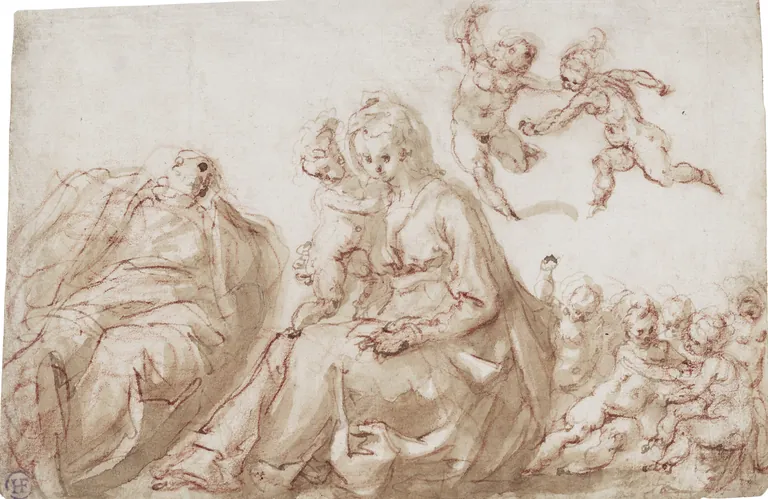
The Holy Family with putti
Red chalk, pen and brown ink, brown wash
5 1⁄8 × 7 3⁄4 in. (13 x 19,7 cm)
17th century frame – 10 13⁄16 × 14 7⁄16 in. (27.5 × 36.7 cm)
Fragmentary watermark initial 'M'
Inscribed ‘di D. Tiepolo’ (verso)
Artwork description
Provenance:
- Hans Fürstenberg (1890-1982), Berlin, Paris, London and Geneva (L. 3615)
- Old Master Drawings, Geneva, 18–19 June 1962, sale at Nicolas Rauch S.A., p. 70, lot 335 (illustrated in the catalogue)
- Sotheby’s, London, 9 July 1981, lot 109
- Nissman, Abromson & Co., Master Drawings 1500-1900, New York, 1992, n° 7 (illustrated in the catalogue)
Literature:
- M. Di Giampaolo, "Cesare Franchi dit Le Pollino. Variations sur le thème de la Sainte Famille", in Disegno, Conference proceedings, Rennes, 1991, p. 21, fig. 5 (illustrated)
- M. Di Giampaolo, "Seguaci: Cesare Franchi detto il Pollino", in Nel Segno di Barocci. Allievi e seguaci tra Marche, Umbria, Siena, Milan, 2005, p. 313, fig. 3 (illustrated)
- S. Prosperi Valenti Rodinò, "Pollino: i disegni" in D. K. Marignoli, Cesare Franchi detto il Pollino miniatore (ca. 1555-1595), Rome, 2020, p. 47 (cited)
A key drawing in the rediscovery of il Pollino as a draughtsman
The present sheet belongs to the first group of drawings identified by Philipp Pouncey (1910–1990) as the work of Cesare Franchi, known as Il Pollino. It was indeed this art historian who was responsible for the rediscovery of the graphic œuvre of this once-forgotten virtuoso draughtsman. Starting in 1958, he brought together a number of drawings sharing similar technique and style(1), including three Holy Families (ill. 1)—among them the present one—which appeared at auction in 1962 and were, quite surprisingly, catalogued as works by Giandomenico Tiepolo, due to an inscription on the verso of our sheet. Since then, the corpus of the artist's drawings has continued to grow, notably thanks to the research of Mario Di Giampaolo.

Little is known about the life of Cesare Franchi, called “il Pollino” (derived from the Latin pullus, meaning “deprived”), a nickname referring to his poor eyesight(2). According to early sources, he worked between Perugia—his native city—and Rome, for “many princes, numerous cardinals, and a few pontiffs, who treated him with distinction”(3). He is known in particular for having produced miniatures offered by Cardinal Scipione Borghese (1577–1633) to the Oratorio dei Nobili in Perugia(4), now housed in the Galleria Nazionale dell’Umbria (e.g. ill. 2) and the Biblioteca Comunale. While these same sources claim that he “excelled in drawing, painting, and miniature painting”(5), only his work as a miniaturist and draughtsman is known to us today - none of his paintings have survived. The very existence of his activity as a painter remains a matter of debate.
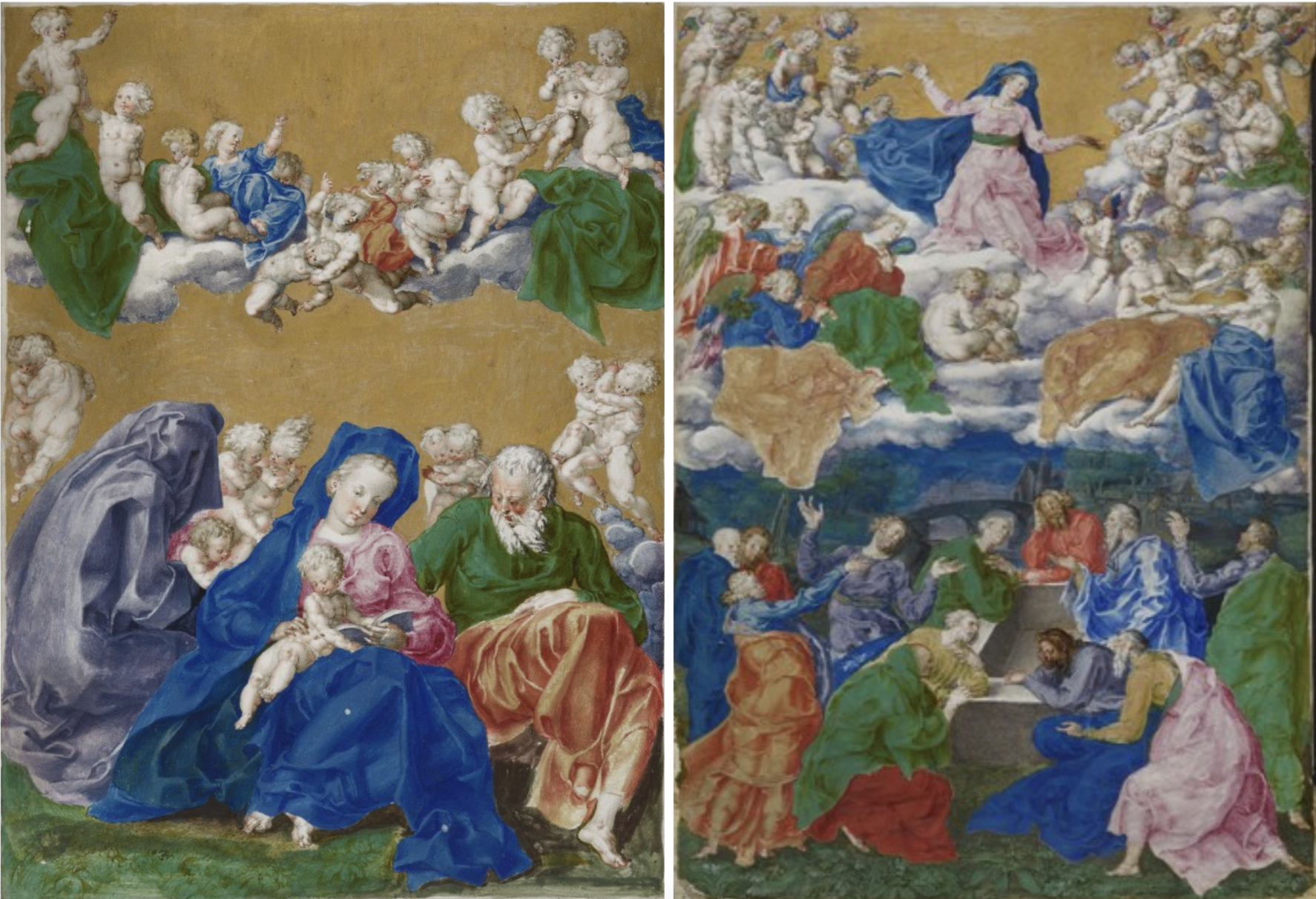
The Holy Family with Angels and The Assumption of the Virgin
Perugia, Galleria Nazionale dell’Umbria
A variation on the Holy Family, a subject dear to il Pollino
This striking Holy Family is characteristic of Pollino’s style—at once gentle and powerful, robust and lithe. Here, he deploys his distinctive, contrasting Mannerism, both deeply personal and rich in references(6). While the Virgin and Child are imbued with a softness that recalls the models of Barocci(7) (1535-1612)—whom Pollino likely studied in Perugia—the figure of Saint Joseph, on the right, is rendered with strong volumes and heavy drapery drawn in bold red chalk and ink, directly evoking the manner of Michelangelo (1475–1564). Furthermore, the swirling dance of putti is intensified by their exaggeratedly elongated and contorted forms, reminiscent of Maarten van Heemskerck (1498–1574).
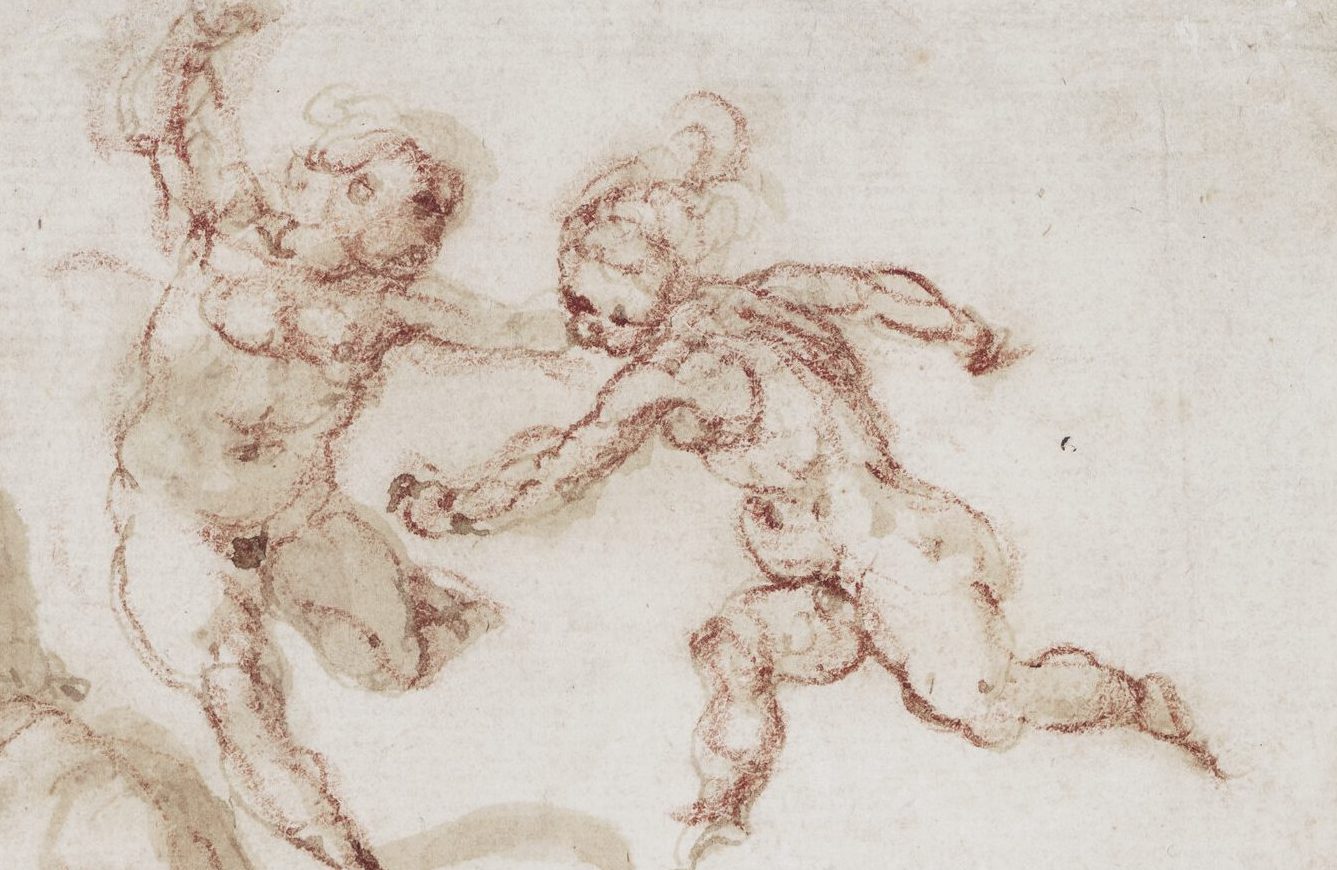
As Mario Di Giampaolo has pointed out, Il Pollino drew the Holy Familyon numerous occasions—a subject that “undoubtedly stimulated the painter’s imagination”(8). All of these studies were executed using the same technique (pen and brown ink wash over red chalk underdrawing) and are of similar dimensions, which has led Simonetta Prosperi Valenti Rodinò to suggest that these drawings once formed part of a single sketchbook, now dismembered and dispersed(9). However, since none of these sheets can be linked to an illuminated work by the artist(10), it remains difficult to determine their precise function with certainty.

In any case, these multiple variations on the same motifs—each time introducing subtle changes in the poses and attitudes of the figures—form a kind of formal laboratory in which the full strength and personality of Pollino’s graphic style unfold. The great Federico Zeri (1921–1998) described it as “one of the pinnacles of 17th entury figurative art”(11).
Framing and condition report
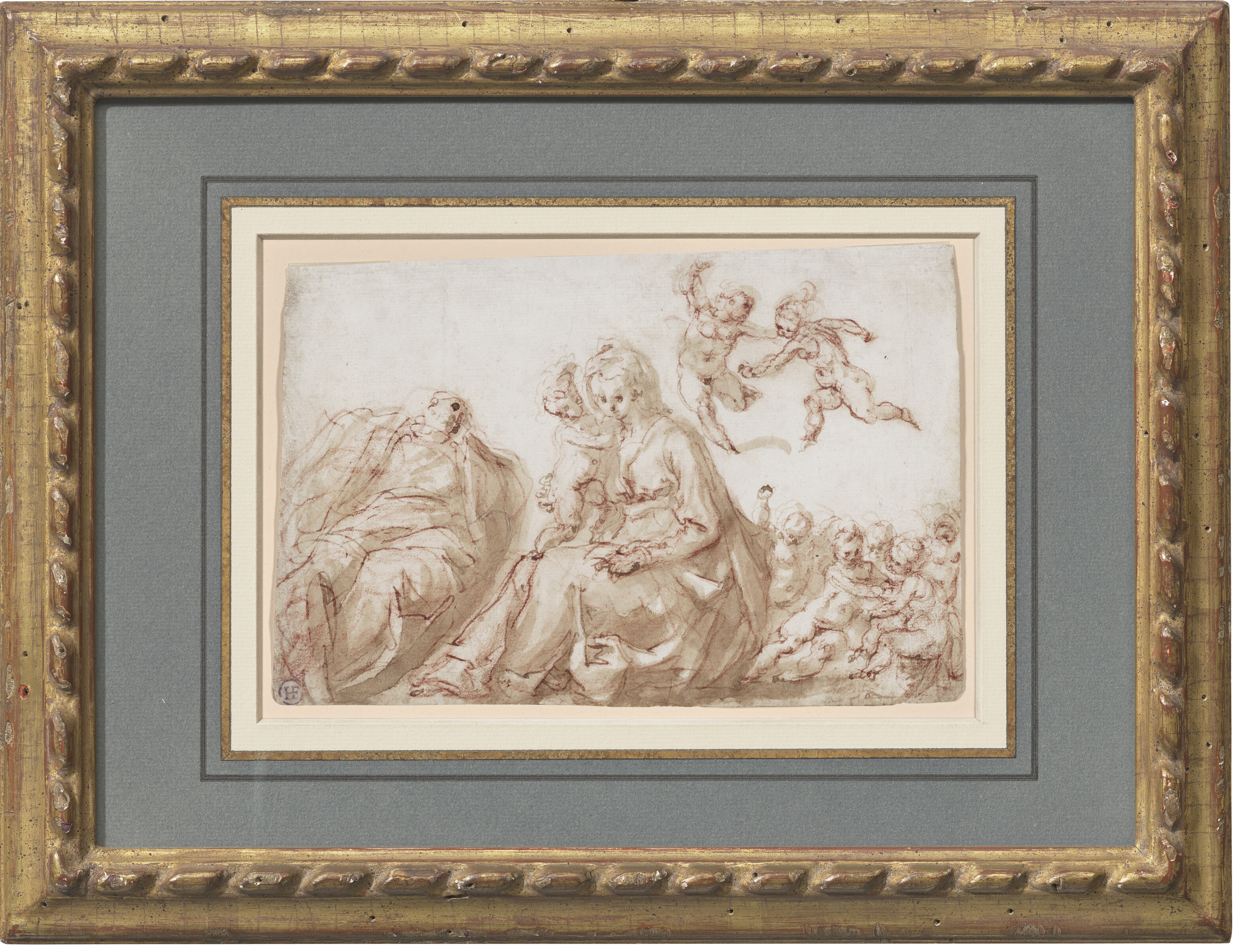
The sheet is mounted in the Mariette style and presented in a 17th century Italian frame. The drawing is in excellent condition, with no notable flaws.
(1) S. Prosperi Valenti Rodinò, "Pollino: i disegni" in D. K. Marignoli, Cesare Franchi detto il Pollino miniatore (ca. 1555-1595), Rome, 2020, p. 47
This group, initially composed of nine studies held at the Graphische Sammlung in Munich, was later expanded - based on stylistic similarities - to include the three Holy Families, among which is our drawing, as well as other sheets preserved in institutions (the National Gallery of Scotland in Edinburgh, Christ Church in Oxford, and the Louvre Museum).
(2) O. Lancellotti, Feste mobili, Biblioteca comunale Augusta, Pérouse, ms, 1886, c. 17 r.
(3) L. Pascoli, Vite de pittori, sculturi ed architetti perugini, Rome, 1732, pp. 167-168
(4) O. Lancellotti, op. cit., ms. 1886, c. 17 r.
(5) L. Pascoli, op. cit., pp. 167-168
(6) M. Di Giampaolo, "Cesare Franchi dit Le Pollino. Variations sur le thème de la Sainte Famille", in Disegno, Conference proceedings, Rennes, 1991, p. 20
(7) Owing to these stylistic similarities, some of his drawings bear the inscription “Cesar Pollino, pupil of Baroche.” However, the historical accuracy of such a master-pupil relationship appears unlikely.
(8) M. Di Giampaolo, op. cit., p. 22
(9) S. Prosperi Valenti Rodinò, "Pollino: i disegni" in D. K. Marignoli, Cesare Franchi detto il Pollino miniatore (ca. 1555-1595), Rome, 2020, p. 47 (cited)
(10) Only one miniature by Il Pollino depicting the Holy Family is known (see ill. 2), and it has not been linked to any known drawing by the artist.
(11) Francesco Piagnani et Livia Nocchi, Atomi e nuvole. Le miniature di Cesare Franchi detto il Pollino (1555 circa–1595), catalogue of the exhibition, Perugia, 2019, p. 5