
Alessandro TURCHI, called L’ORBETTO
(Verona, 1578 - Rome, 1649)
The Gathering of Manna
Circa 1605
Pen and brown ink, brown wash, blue wash, white gouache on buff paper
24 ¹³⁄₁₆ × 28 ³⁄₈ in. (63 × 72 cm)
Inscrit à la plume « Giuseppe Porta detto Salviati » en bas à gauche
17th century Italian gilt frame
Artwork description
Provenance:
- Zaccaria Sagredo (Venice, 1653–1729) (L.2103a), his pen inscription “S.V. n° 91” (for " scuola veneta ") on the verso
- Ader-Picard-Tajan sale, Paris, 11 June 1990, lot 46, as “Paolo Farinati”
- Galerie La Scala, Paris
- Acquired from this gallery in 1991 by a Parisian collector couple; thence by descent to the present day
Literature:
- H. Sueur, « Propositions pour Pasquale Ottino dessinateur », in Verona Illustrata, no. 5, Verona, 1992, pp. 57-59, fig. 40 (reproduced)
- S. Marinelli, « Da Turchi a Gramatica: integrazioni al Seicento », in Verona Illustrata, no. 14, Verona, 2001, p. 46, note (cited)
- D. Dossi, « La giovinezza dell'Ottino e un dipinto inedito », in Proporzioni, no. 7/8, Florence, 2006-2007, pp. 75-76 (cited)
- G. Peretti, in D. Scaglietti Kelescian (dir.), Alessandro Turchi detto l'Orbetto, 1578-1649, Verona, 2019, p. 48 (cited)
We warmly thank Professor Sergio Marinelli for confirming the attribution of the drawing to Alessandro Turchi (written communication, 19 January 2026). A specialist in Veronese art, he has published numerous studies on this artist and his contemporaries.
A preparatory study reattributed to Alessandro Turchi
This drawing, of a spectacular size, is connected to the large painting The Gathering of Manna (ill. 1), preserved in the church of San Giorgio in Braida in Verona. Probably commissioned in 1600, the canvas was begun by Felice Brusasorci (1542–1605) and then completed, after his death in 1605, by his two pupils: Pasquale Ottino (1578–1630) and Alessandro Turchi. The painting is still displayed in the church alongside its pendant,The Multiplication of the Loaves, painted by Paolo Farinati (1524-1606)(1).
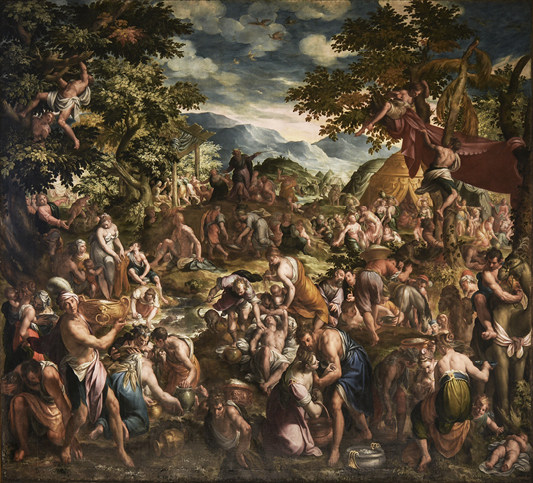
The Gathering of Manna
Oil on canvas, 295 ¹⁄₄ × 334 ⁵⁄₈ in. (750 × 850 cm)
Verona, Church of San Giorgio in Braida
As Hélène Sueur observes, “the exceptional dimensions of the sheet, the care given to its execution, the attention to detail, and the freedom of the handling strongly encourage us to see in it a preparatory project(2) rather than a mere copy after the painting. Sergio Marinelli develops this idea further, seeing in it a “plan of redefinition”(3) of the composition, executed after Brusasorci’s death by his pupils in order to introduce modifications before completing the canvas. While Hélène Sueur attributed the drawing to Pasquale Ottino, this attribution has been rejected by Davide Dossi and by Sergio Marinelli, who recognizes - without reservation - the hand of the young Alessandro Turchi(4). It is worth noting that a copy of our drawing is preserved in the University Art Museum at Princeton (inv. x1948-1261). Smaller (42 × 55 cm) and of much more modest quality(5), it nonetheless aligns perfectly with the present sheet, including in its divergences from the final painting.
Nicknamed L’Orbetto, probably because his father was blind in one eye ( orbo ), Turchi settled in Rome in 1614, where he remained until his death. After working on the decoration of the Sala Regia in the Quirinal Palace, he attracted the attention of Cardinal Scipione Borghese (1577–1633), for whom he painted The Dead Christ with Mary Magdalene and Angels and The Raising of Lazarusboth still preserved in the Galleria Borghese. From that point on, his success never waned. He was appointed head of the Accademia di San Luca in 1637 and worked until his death for the most eminent patrons. His works were especially sought after by distinguished French collectors, “who must have greatly appreciated the blend of classicism and realism, tinged with northern nuances, that characterizes his art”(6). Félibien, sensible à cette esthétique, dit d’ailleurs le préférer à Velázquez(7). Among his most illustrious Parisian collectors were Richelieu, Mazarin, and Louis Phélypeaux de La Vrillière, for whom he painted the celebrated Death of Cleopatra, now displayed in the Grande Galerie of the Musée du Louvre (inv. 703).
A turbulent drawing for a dramatic scene
The work depicts an episode from theBook of Exodus (Ex. 16:14): in order to feed the Jewish people in the desert, God causes each morning a granular substance to appear on the ground - the manna. The artist shows us here the very first gathering, when the miracle occurs in extremis as the Hebrews were dying of hunger. The scene unfolds in great confusion, within a tormented landscape, amid lifeless bodies (note the half-naked man lying in the foreground at the center of the composition, and the dead infant depicted in a striking foreshortening in the lower right corner of the sheet). Dozens of scattered groups, accompanied by their animals, rush forward - both on the ground and climbing into the trees - to collect the precious substance in makeshift containers. Overlooking the composition from a hill, Moses, recognizable by his horns(8)appears to be attempting to impose order on the gathering.
The drama of the scene is heightened by the poses of the figures, often depicted in impossible twists, sometimes with prominent musculature and in bold, violent foreshortenings. This impression of chaos and movement is further emphasized by a strong chiaroscuro, created through the subtle interplay of the brown wash and white heightening.
(1) G. Peretti, dans D. Scaglietti Kelescian (dir.), p. 48
(2) H. Sueur, 1992, p. 57
(3) S. Marinelli, 2001, p. 46, note
(4) Written communication, 19/01/2026
(5) G. Peretti, op. cit., p. 48.
(6) S. Marinelli, in A. Dary (ed.), L’Œil et la passion 2 : Dessins baroques italiens dans les collections privées françaises, exhibition catalogue, musée des Beaux-Arts de Rennes, Paris, 2015, p. 192
(7) A. Félibien, Entretiens sur les vies et les ouvrages des plus excellents peintres anciens et modernes, 5th part, 9th entretien, Paris, 1688, pp. 15-17
(8) The depiction of Moses with horns derives from a Latin translation of the Bible by Saint Jerome, in which the Hebrew verb qaran, meaning “to shine” or “to emit rays,” was interpreted as “to bear horns.” This reading gave rise, for centuries, to an iconographic tradition showing Moses with horns.