
Venice, early 17th century Italian gilt frame
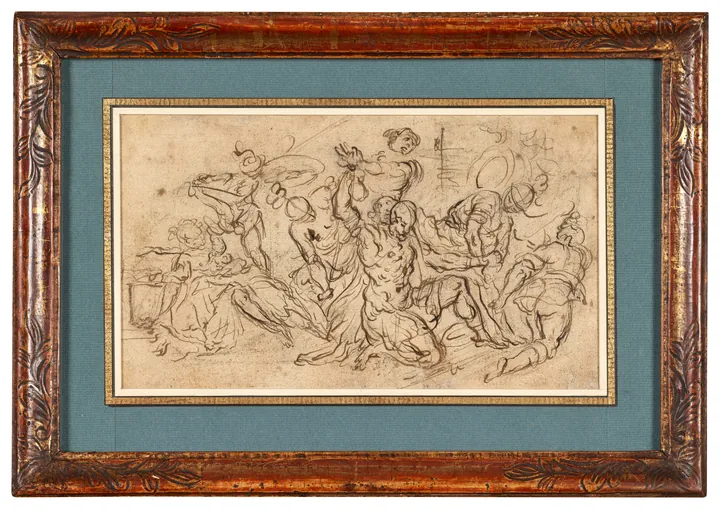
Samson captured by the Philistines (?)
Venice, early 17th century Italian gilt frame
Pen and brown ink over black chalk
Old pen inscription on the verso (accountancy)
5 ¹⁹⁄₃₂ × 9 ²¹⁄₃₂ in. (14.2 × 24.5 cm)
Louis XVI period frame – 9 ¹⁴⁄₃₂ × 13 ¹²⁄₃₂ in. (24 × 34 cm)
An anonymous drawing to be situated in early Seicento Venice
Bare-chested and kneeling on one knee, the central figure is surrounded by four soldiers in the act of binding him. Behind him emerges a frontal figure, whose face is visible, along with a long garment whose drapery frames the restrained man. On the left side of the composition, another warrior, very summarily sketched, strides triumphantly over a prone body, whose skull appears to be wounded. In the background to the right, faintly indicated shields suggest the presence of additional soldiers.
The graphic style of the present drawing immediately points to Venice around the turn of the sixteenth and seventeenth centuries. The physiognomies - particularly that of the central figure - directly recall Tintoretto and Palma il Giovane (1544–1628), yet rendered in a more agitated and synthetic manner that appears later in date and already oriented toward the emerging Baroque. This free and vigorous style seems especially close to that of Padovanino (1588–1649) and of the Master of the Palma Album in Munich, sometimes identified as Antonio Cecchini (1600–1687)(1), although no specific hand can be securely identified.
A subject open to conjecture
Although no element of the composition allows the subject to be identified with certainty, an initial analysis suggests that it may represent Samson captured by the Philistines. This episode from the Book of Judges (Judg. 13:1–16:31) recounts the moment when Samson, betrayed by Delilah and deprived of his hair - the source of his superhuman strength - is seized by several Philistine warriors, who bind him before blinding him. The bare-chested man with heroic musculature would thus be the Jewish hero, while the figure visible behind him could be identified as Delilah. It is furthermore worth noting the similarities in the poses of certain figures in the drawing with an engraving after Titian representing the same subject (ill. 1). This interpretation, however, does not fully account for the group on the left, in which a soldier tramples a corpse. One might therefore instead consider the martyrdom of a saint or, more simply, a scene of soldiers binding a prisoner after a battle.

Samson captured by the Philistines
Woodcut engraving
Be that as it may, through the singular handling of the drawing the artist conveys the full violence of the subject. The figures, rendered in contorted poses and daring foreshortenings, are treated synthetically with a nervous, vigorous pen; the scene appears to be captured on the spot, in all its tension and confusion. This great vitality of execution, combined with the simplified forms of the figures, lends the drawing a strikingly modern quality (dare we risk the anachronism!).
(1) Voir notamment Bert W. Meijer, Il disegno veneziano 1580-1650, Ricostruzioni storico-artistiche, Florence, 2017, pp. 109-119 and 311-326